
Chapter 6 of 8·6 min left in book
Chapter 6
Staying safe: what good supervision looks like

Safety on these medications is not luck. It is a set of specific, repeatable practices — and most of them happen where you cannot see them. So here is what monitoring actually consists of.
What we watch, and when
- Before you start — kidney function, plus a baseline picture of your metabolic health: blood sugar, lipids, liver function, thyroid.
- At every visit — weight and heart rate. These medications nudge heart rate up modestly.
- Every two to three months at minimum — a genuine review of progress, more often early on.
- Once a year — lipids, a metabolic panel, liver function, A1C, thyroid. These look for the causes and consequences of obesity itself, not only the effects of the medication.
- Whenever symptoms call for it — kidney function again, particularly if vomiting or diarrhea has left you dehydrated.
- Body composition where available, so we can see what kind of weight you are losing rather than guessing.
Alongside that: raise the dose only when you are tolerating the current one, and review every other medication you take at the start rather than after a problem appears.
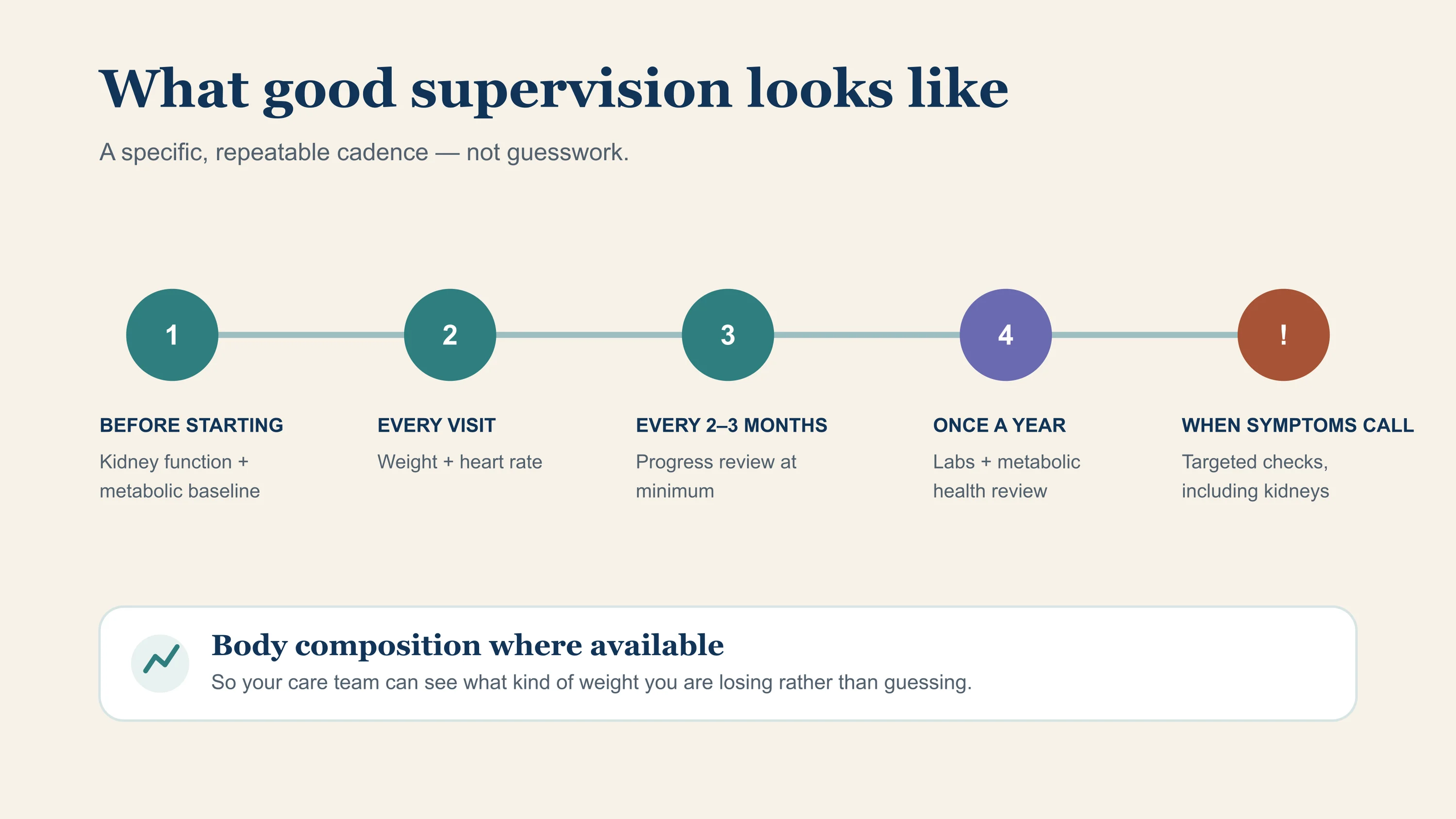
Safety is a cadence of checks, reviews, and adjustments — not luck.
If you take insulin or a sulfonylurea, that review is not a formality — those medications lower blood sugar on their own, and stacking them can push you too low. Expect to check your blood sugar at least daily while starting and while doses climb, and expect those doses to come down. If you take birth control pills, turn back to Chapter 4.
You will not be wasting anyone's time. Managing these calls is part of the treatment, not an interruption to it.
"Will I be on this forever?"
The most common question I get, and it deserves a straight answer rather than a comfortable one.
What it means in practice varies more than people expect. Some patients stay on treatment long term. Others step down to a lower maintenance dose and hold their results there. Some come off entirely and maintain with lifestyle, strength training, and regular follow-up. Research into maintenance dosing and structured off-ramps is active and moving quickly.
Chapter summary
What to take away
- Side effects happen because these medications amplify a hormone you already make. Your body needs time to adjust.
- Most are digestive, mild, and improve with unhurried dose increases. Roughly three in four people never experience nausea at all.
- Protecting muscle is part of the treatment, not an optional extra: pace, protein, resistance training.
- The serious risks are real and rare. Keep "this can happen" separate from "this will happen to me."
- If you could become pregnant, this changes your contraception. Ask before you start.
- The medication matters. So does knowing where it came from, and having someone watching.