
Chapter 1 of 8·23 min left in book
Chapter 1
Why side effects happen at all

Every medication has side effects. That does not mean it is unsafe. It means the medicine is active in your body.
It helps to know what these medications actually are, because the name gets used as though it describes a foreign chemical. It does not.
GLP-1 stands for glucagon-like peptide-1. It is a hormone you already make. Your intestine releases it every time you eat. It tells your brain you have had enough, slows how quickly your stomach empties so fullness lasts, and signals your pancreas to manage blood sugar.
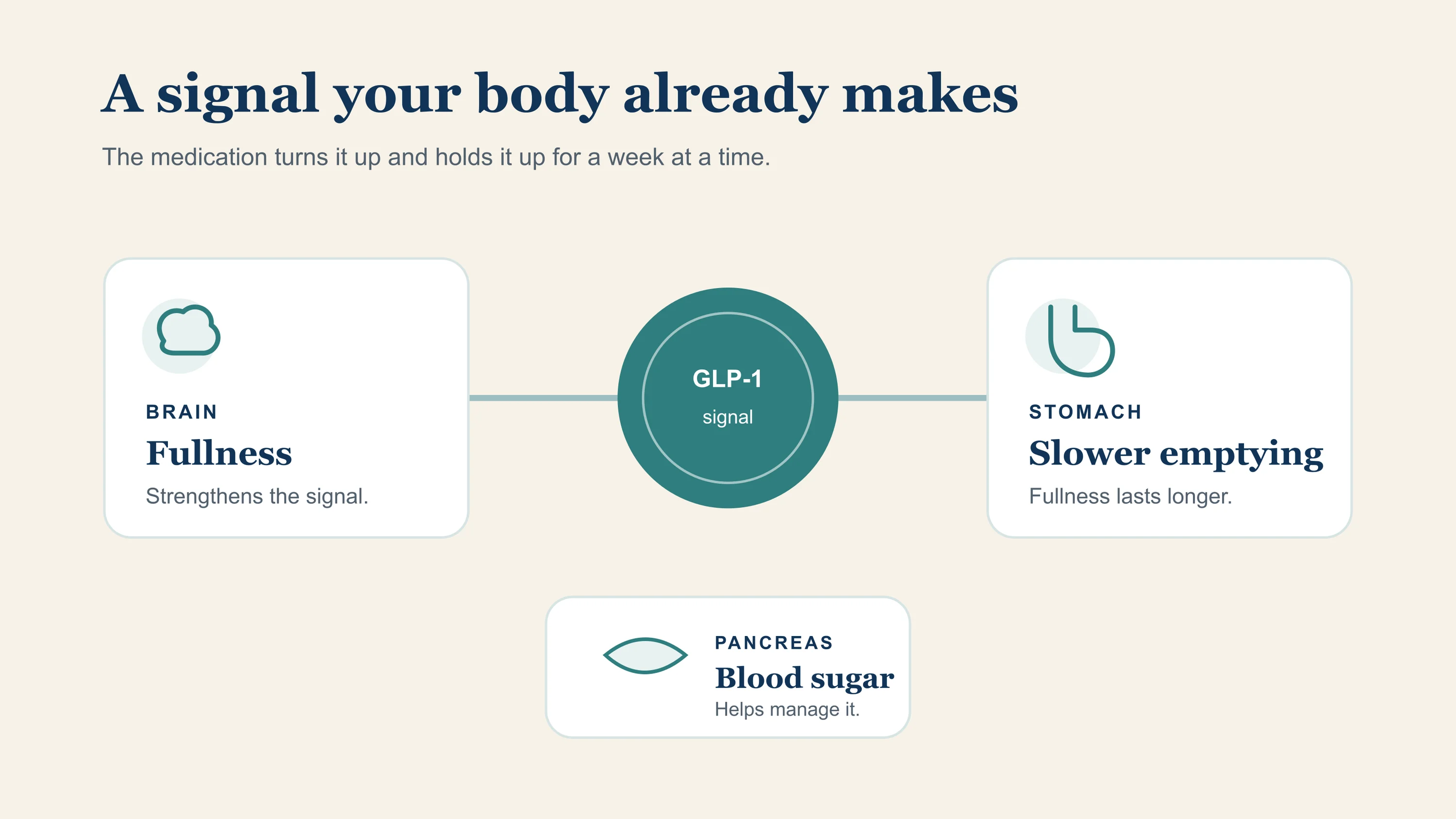
GLP-1 carries three familiar messages: fullness, slower stomach emptying, and blood sugar management.
This is not a stimulant. It is a copy of a signal your body produces on its own — one that, in people living with obesity, often does not work as strongly as it should. The medication turns that signal up and holds it up for a week at a time. Your body has to adjust to the new volume.
Think of it like turning up a speaker. At first the sound feels too loud. Over time your ears adjust, and it feels normal again.
That explains the pattern almost completely. Side effects cluster in the first few weeks, cluster again after a dose increase, and for most people fade as they continue.
Where you feel it
In your gut. GLP-1 slows stomach emptying — that is how it keeps you full for hours instead of minutes. It is also why nausea, bloating, and constipation are the most common complaints. The benefit and the side effect come from the same mechanism.
In your brain. GLP-1 strengthens fullness and quiets what patients describe as constant food chatter. Early on, some people read that unfamiliar signal as discomfort rather than satisfaction.
In your metabolism. GLP-1 improves blood sugar control — which is why every other medication you take needs reviewing before you start, not after. Chapter 6 covers what that involves.
The two kinds of side effects
Almost every worry I hear in clinic sorts into one of two piles. Keeping them separate is the most useful thing you can take from this book.
Common and mild. Nausea, constipation, bloating, loose stools. They affect a lot of people, they are usually manageable with simple adjustments, they improve as your body adapts, and most people never need a prescription to treat them. Uncomfortable, not dangerous.
Rare and serious. Pancreatitis, gallbladder problems, and a short list of others. Real, worth knowing — and uncommon.
Nearly everything alarming you have read online blends these two piles together. A rare complication and a routine first-week symptom get listed in the same paragraph, in the same tone. That is what makes these medications sound frightening.
Separated, they are two different conversations. Chapter 2 is the first pile. Chapter 4 is the second.