
Chapter 2 of 8·21 min left in book
Chapter 2
The common side effects, and what actually helps

How common is "common"?
Here are real numbers from the trials that supported approval — alongside what happened to people in those same trials who received a placebo injection instead.
| Out of every 100 people | On the medication | On placebo |
|---|---|---|
| Felt nauseated | 25 to 29 | 8 |
| Had diarrhea | 19 to 23 | 8 |
| Became constipated | 11 to 17 | 5 |
| Vomited | 8 to 13 | 2 |
Data: The clinical trials that supported approval — see the Sources chapter.
Read the first row again, because it is the opposite of what the headlines suggest: roughly three out of four people did not experience nausea at all. And eight in a hundred felt nauseated on a placebo, meaning some of it was never the drug.
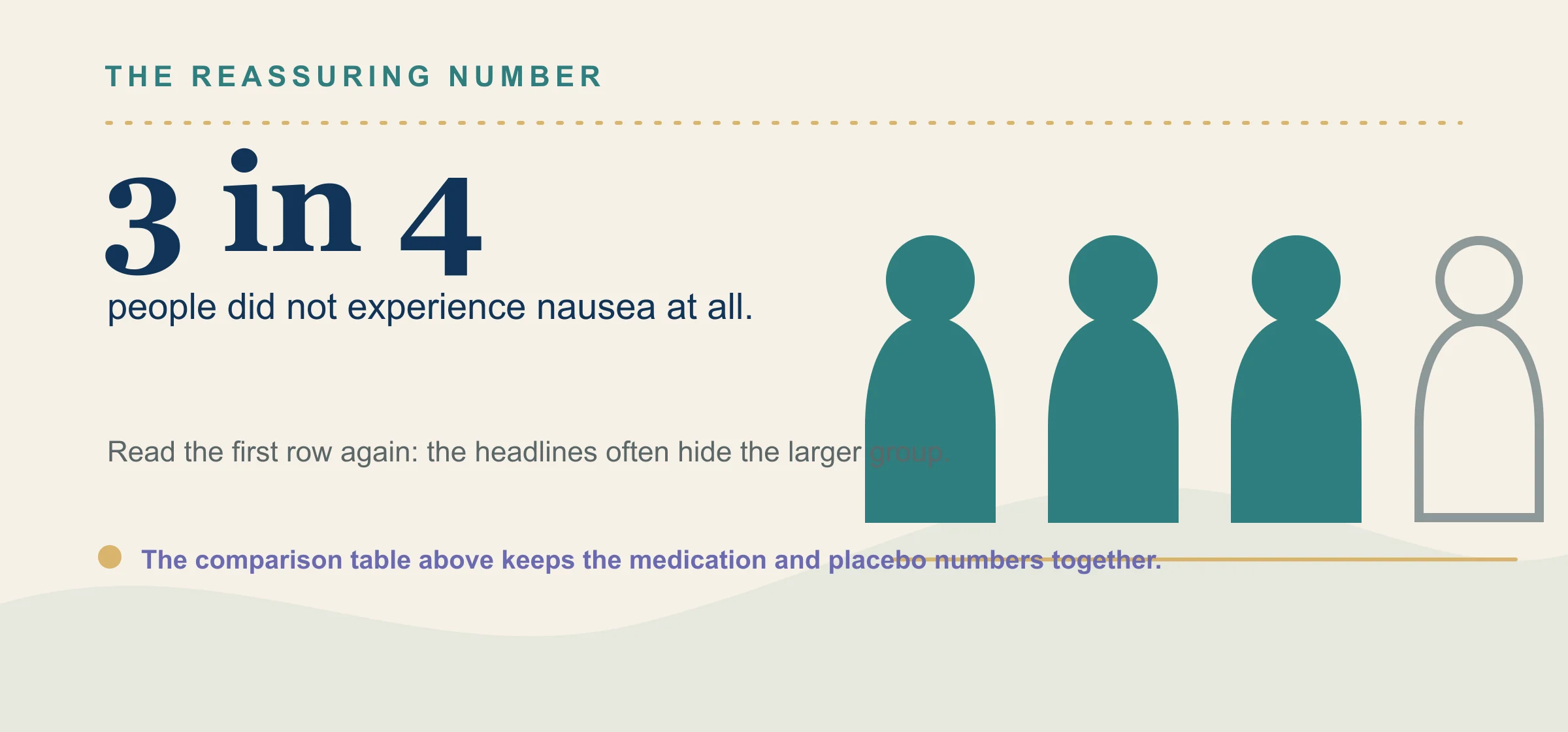
Roughly three out of four people did not experience nausea at all.
Nausea
The most common by a wide margin. Food is staying in your stomach longer, and your stomach notices. It typically settles after the first few weeks, or once a dose holds steady.

Smaller portions and stopping at the first sign of fullness can make a meaningful difference.
Vomiting
Usually a signal rather than a mystery. It most often follows a dose increase that came too soon, or a meal too large or too rich.
Keep portions small and tell your provider. Pausing at your current dose is a normal clinical adjustment — not a setback, and not a failure on your part. Vomiting that will not stop, or that prevents you keeping fluids down, needs a phone call the same day.
Constipation
Everything is moving more slowly, including through your intestines. Far easier to prevent than to fix, so start in week one rather than week four.
Water through the day. Fiber from vegetables, fruit, beans, and whole grains — 20 to 35 grams daily is the target, and most people start well below it. Regular movement, even walking. If that is not enough, an osmotic laxative such as polyethylene glycol (MiraLAX) or a stool softener is the usual next step. Ask your provider first.
The others
Diarrhea. Usually mild and early. Ease off high-fat foods, stay hydrated, add electrolytes if it lasts more than a day. Soluble fiber firms things up rather than making it worse.
Bloating and belching. Slower digestion plus swallowed air. Eat slowly, skip carbonated drinks, go easy on fatty meals.
Heartburn and reflux. A slow-emptying stomach can push acid upward, particularly at night. Smaller evening meals, nothing within about three hours of bed, and raising the head of your bed all help. An acid reducer such as famotidine is a reasonable next step — ask first.
Injection-site soreness. Ice the spot for about 60 seconds before injecting, and rotate sites.
For most people, all of this fades within a few weeks.
Why we start low and go slow
Semaglutide (Wegovy) starts at 0.25 mg weekly and rises toward 2.4 mg. Tirzepatide (Zepbound) starts at 2.5 mg weekly and steps up in 2.5 mg increments toward a maximum of 15 mg.
The label permits an increase only after at least four weeks at your current dose, and then only if you are tolerating it. Read that as a floor, not a schedule you are falling behind on.
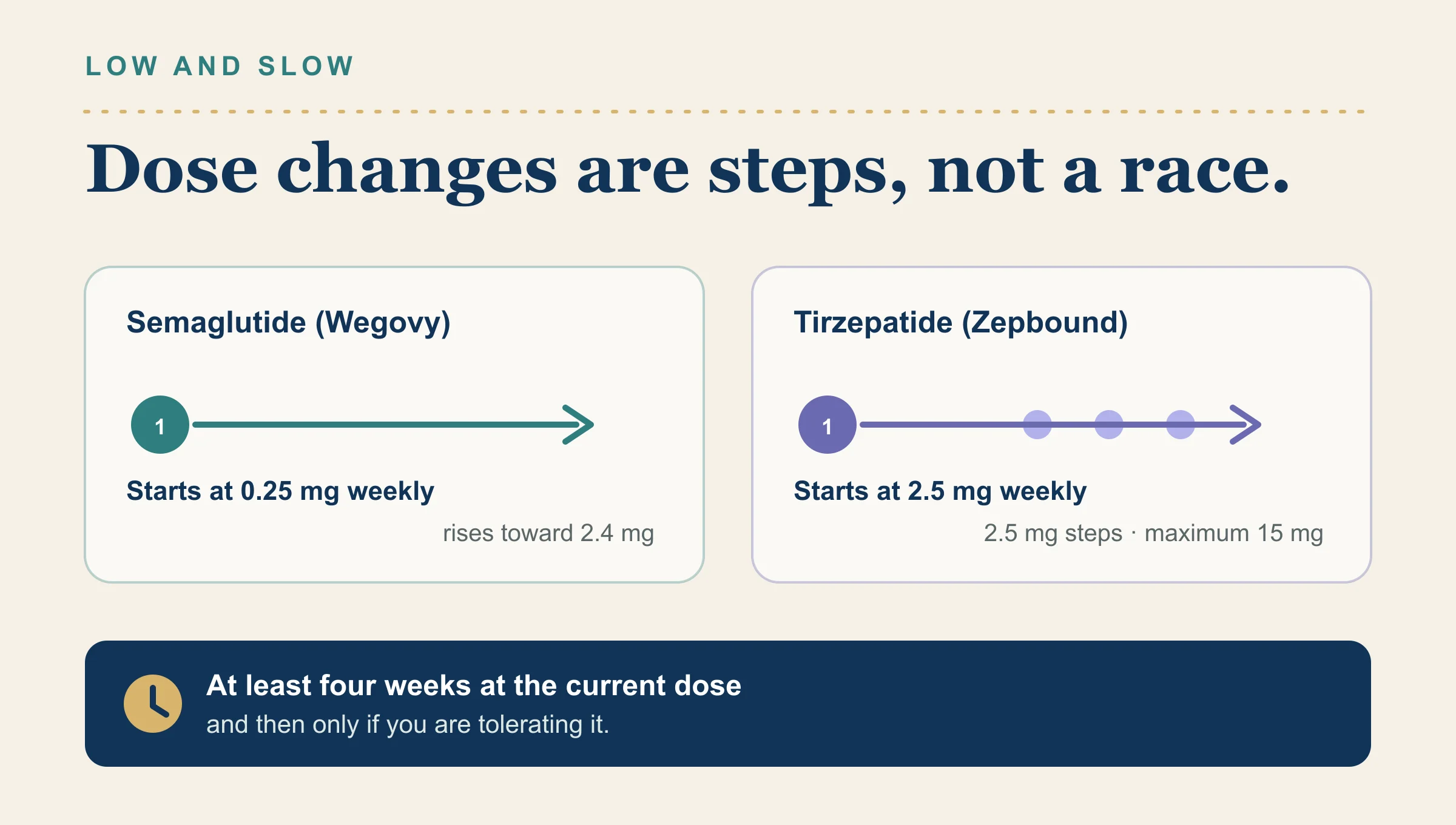
Low and slow is the design: at least four weeks at a dose, then an increase only if you are tolerating it.
Here is the part that surprises people most: not everyone needs to reach the maximum dose. The right dose is the one giving you results with side effects you can live with. For plenty of people that is two steps below the top, and staying there is a deliberate clinical decision — not settling.
I remember a patient who had mild nausea in week one, then something more intense in week three. She called. We went through how bad it actually was, and it was within an acceptable range. We recommended smaller portions, ginger, peppermint. By the second month her nausea had improved significantly. She never needed me to prescribe Zofran — and most people never do.
One key thing in managing side effects is to use the lowest effective dose — the one giving you around two to three pounds of weight loss in a week, and no more.
When even the starting dose is too much
Occasionally someone cannot tolerate even the lowest approved starting dose.
The standard references do not endorse using amounts smaller than the label specifies: it has not been formally studied, responses vary, and drawing up a partial dose introduces real risk of measurement error. That is the mainstream position, and it is a fair one.
My practice differs in a narrow set of cases. For a patient doing well otherwise who cannot tolerate the starting dose, I would rather find a smaller amount she can actually take, under close supervision, than lose the treatment altogether. Some patients have done genuinely better this way. But that is a decision made with a physician who is watching you — not something to attempt alone, and not a reason to buy a vial and a syringe from a website.
If you miss a dose
For tirzepatide, take it as soon as you can within four days — 96 hours — of when it was due. Past that, skip it and take your next dose on your regular day. Do not double up. Check the instructions for your own medication, since the window differs between products.
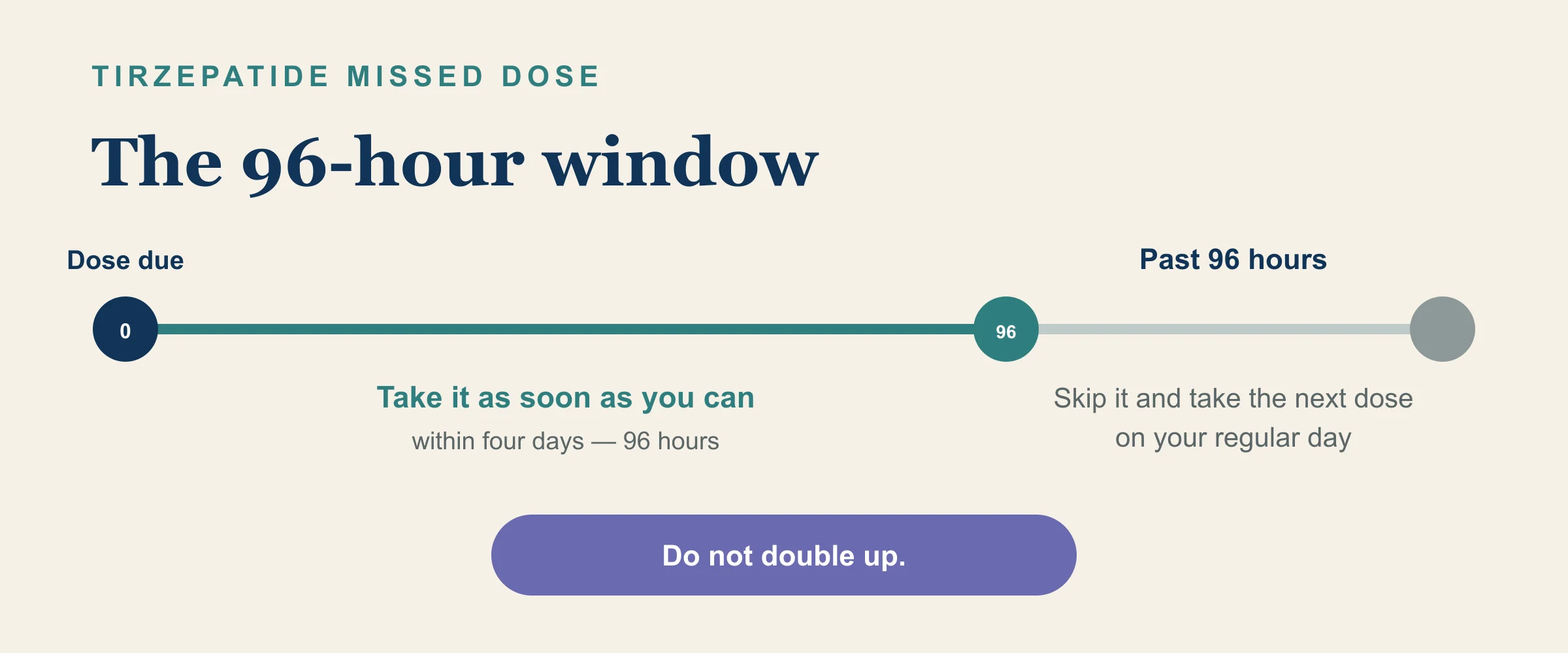
For tirzepatide: take it within 96 hours. After that, skip it and return to your regular day.
Chapter summary
Keep these three things in mind
- Symptoms are usually mild to moderate, cluster around a dose increase, and improve with time.
- The right dose is the one giving you results with side effects you can live with.
- Do not double up.