
Chapter 4 of 8·14 min left in book
Chapter 4
The rare risks, in proportion
Now the second pile — the risks worth knowing, and the ones most distorted by headlines.
When someone asks whether these medications will damage their kidneys or liver, I ask them about Tylenol. It sits in almost every medicine cabinet in America, taken billions of times a year without incident. It is also one of the leading causes of acute liver failure in this country. Both are true at once, and the rare outcome tells you almost nothing about what happens when you take two tablets for a headache.
"This can happen" and "this will probably happen to me" are different statements. Almost everything below belongs in the first.
Kidneys and liver
Kidneys. These medications are not directly toxic to your kidneys. The risk is indirect and preventable: severe vomiting or diarrhea leaves you dehydrated, and dehydration can injure the kidneys. That is why hydration is not throwaway advice, and why persistent vomiting warrants a call rather than patience. Reduced kidney function does not necessarily rule you out, but it must be known and monitored before you start.
Liver. Here the news runs the other way. Many people carrying excess weight also carry fat in the liver, which untreated can progress to inflammation and scarring. These medications have been studied in fatty liver disease with encouraging results — for many patients, effective weight treatment improves the liver.
Pancreatitis
Inflammation of the pancreas. Rare, serious when it happens.
The warning sign is severe abdominal pain, often boring through to your back, usually with nausea or vomiting. This is not ordinary GLP-1 queasiness — patients who experience it describe a different order of pain entirely. Stop the medication and seek care immediately.
The evidence is less settled than either side of the argument suggests. Studies following large populations have reported pancreatitis, bowel obstruction, and delayed stomach emptying more often among people taking GLP-1s than among people taking a different weight-loss medication. But those groups differ in many ways besides the drug, and a pattern of that kind is not a cause. That these medications cause pancreatitis has not been established.
Gallbladder problems
Rapid weight loss of any kind raises the risk of gallstones — after surgery, after aggressive dieting, with medication alike. GLP-1s add modestly to that.
The trial numbers give you the scale: gallbladder inflammation in roughly 0.7 percent of people taking tirzepatide, against 0.2 percent on placebo. Higher, and still fewer than one in a hundred.
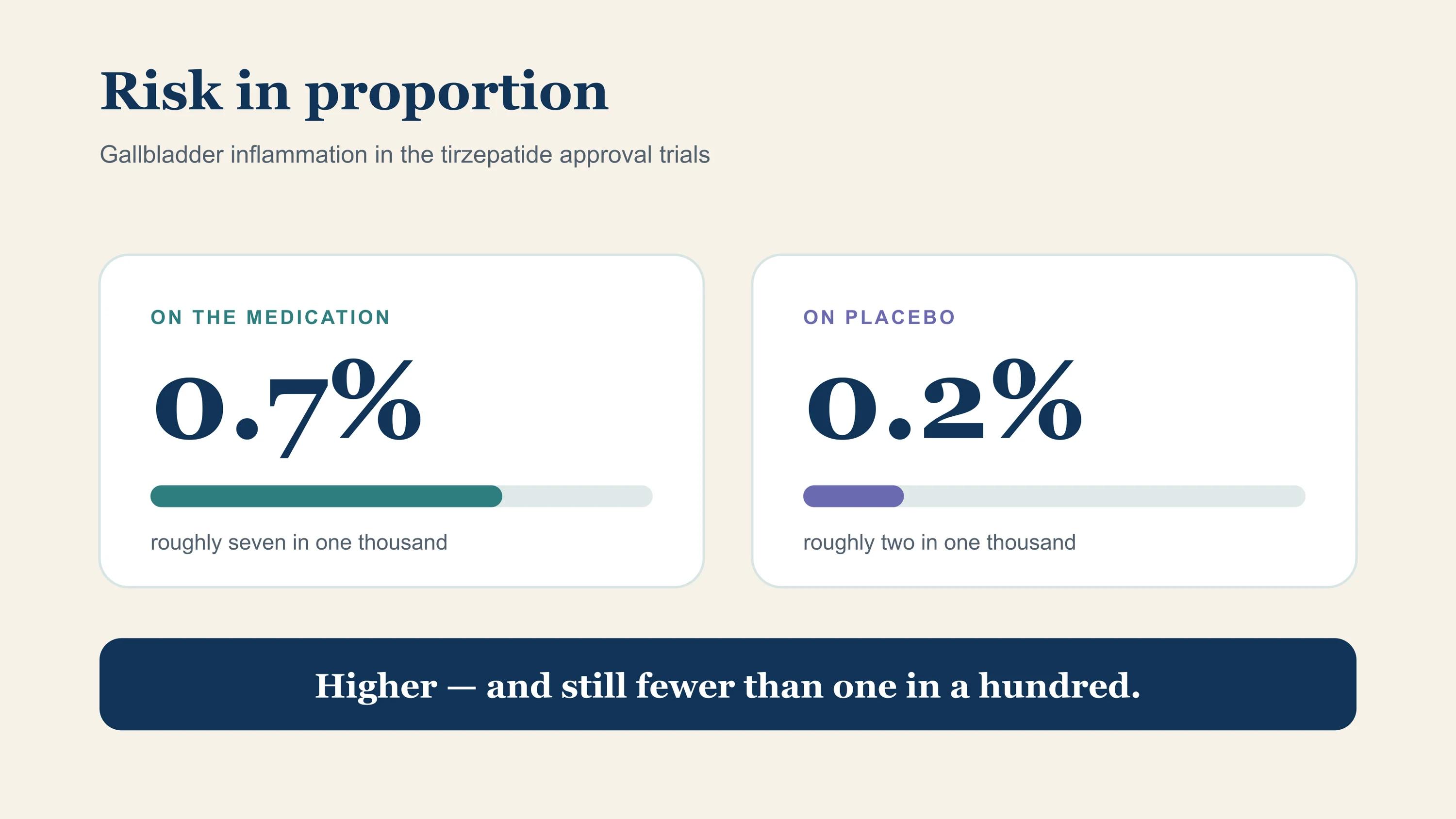
Gallbladder inflammation was higher on tirzepatide — and still occurred in fewer than one in a hundred people.
A steadier pace of loss and good hydration both help. Persistent pain in the upper right abdomen, particularly after fatty meals, is worth a call.
Eye changes
Cases of sudden vision loss involving the optic nerve have been reported with semaglutide, and labeling has been updated to reflect it. It appears rare, and whether the medication causes it is still under study. If that specific condition is confirmed, the medication is stopped permanently.
If you have diabetes with existing retinopathy, that must be known before you start — doses are raised more slowly, and paused if your retinopathy worsens.
Any sudden change in your vision needs attention the same day.
Before any surgery or procedure
The most practical item in this chapter, and almost nobody mentions it.
Because these medications slow stomach emptying, food can remain in your stomach far longer than expected — even after you have followed standard fasting instructions. Under sedation, that raises the risk of stomach contents entering the lungs.
Tell every surgeon, anesthesiologist, dentist, and proceduralist that you take a GLP-1 — well before the day, not while you are being wheeled in. Guidance on holding the medication has been evolving, and your care team needs the chance to plan. Put it on your medication list. Say it out loud at the pre-op visit.
The cancer question
Patients ask me about this more than anything else. It deserves a direct answer rather than a reassuring deflection.
Where the concern comes from. In studies where rats and mice received high doses across their lifetimes, some developed tumors of the thyroid C-cells. That animal finding is why these medications carry a boxed warning.
What it means for people. Rodent and human thyroid tissue differ meaningfully — human C-cells carry far fewer of the relevant receptors. A causal link to medullary thyroid cancer in humans has not been established. The strongest human evidence comes from Scandinavia, where researchers used the national health databases of three countries and found no increase in thyroid cancer over a median of about three years, compared with people taking a different diabetes drug. Three years is not a lifetime, and this remains under watch — but it points the same way as the biology.
What we do not do. Routine calcitonin tests and screening thyroid ultrasounds are not recommended. They have not been shown to help, and they reliably turn up incidental findings that lead to more scans and more anxiety without making anyone safer.
On cancer more broadly. No established causal link to other cancers. And it is worth seeing the whole ledger: obesity is itself a well-documented risk factor for more than a dozen cancers. Treating it effectively is not a neutral act, and doing nothing is not the risk-free option it appears to be.
Mood
Reports of suicidal thoughts prompted formal reviews by regulators in the US and Europe. Those reviews did not find evidence that these medications cause suicidal ideation.
That said — if your mood shifts on any medication, tell your provider rather than waiting to see whether it passes.
If you could become pregnant
The item most often left out, and it has real consequences.
These medications are not used in pregnancy. If you become pregnant while taking one, it is stopped. That part is straightforward — which is what makes the next part matter.
If you take tirzepatide and use birth control pills, the pill may not protect you as reliably. The same slowed stomach emptying that keeps you full changes how the pill is absorbed. Use a backup barrier method for four weeks after you start, and for four weeks after every dose increase — not just the first.
This applies to tirzepatide specifically, not the other GLP-1 medications, and to pills specifically: an IUD, implant, injection, or patch is unaffected.
If pregnancy is something you are planning rather than preventing, say so early. Breastfeeding has a simpler answer: these medications are not used during it, because the safety data are not there.
And one in its own category: a prior episode of pancreatitis — a strong caution rather than an absolute bar. Whether it rules you out depends on what caused it and whether that cause has been dealt with. Someone whose pancreatitis came from gallstones and who has since had their gallbladder removed is in a different position from someone whose cause was never identified.
This list is why a real medical assessment comes before a prescription, and why a questionnaire on a website is not the same thing.