
Chapter 3 of 8·17 min left in book
Chapter 3
The changes you can see

GLP-1 medications reduce fat, including the visceral fat packed around your organs — the fat that carries the most health risk and the least visible presence. But fat does not leave evenly, and losing it quickly can show in places you did not expect.
"Ozempic face" and "Ozempic butt"
These nicknames describe fat loss in the face or buttocks that leaves a hollowed look or looser skin.
The cause is not the medication doing something strange to your face. It is fat loss that is rapid, uneven, and revealed by skin that does not shrink as fast as the volume underneath it. It is also not new — the same thing has always followed bariatric surgery and any rapid weight loss. It simply did not have a brand name before.
Several things make it more noticeable:
- Pace. Fast loss gives skin no time to adapt.
- Age. Skin elasticity declines. The factor you cannot change.
- Total amount lost. More weight, more visible change.
- How much muscle you keep. Muscle is the structure underneath — the factor you control most.
Cosmetic treatments are reasonable for some people, but they are not where I start and they do not address the cause.
Losing muscle along with fat
All weight loss costs you some lean mass — dieting, surgery, and medication alike. The goal is not to avoid it entirely, which is impossible, but to keep the loss small. Muscle holds your metabolic rate up, keeps you strong as you age, and makes regain less likely if you come off treatment. The same is true of bone, which is easier to forget because you cannot see it.
Here is the honest number, and it is larger than most people expect. A review pooling 35 studies found roughly 28 percent of total weight lost on these medications came from muscle. Researchers generally treat 25 percent as the expected benchmark for weight loss of any kind — and in nearly two thirds of those studies, muscle loss exceeded it.
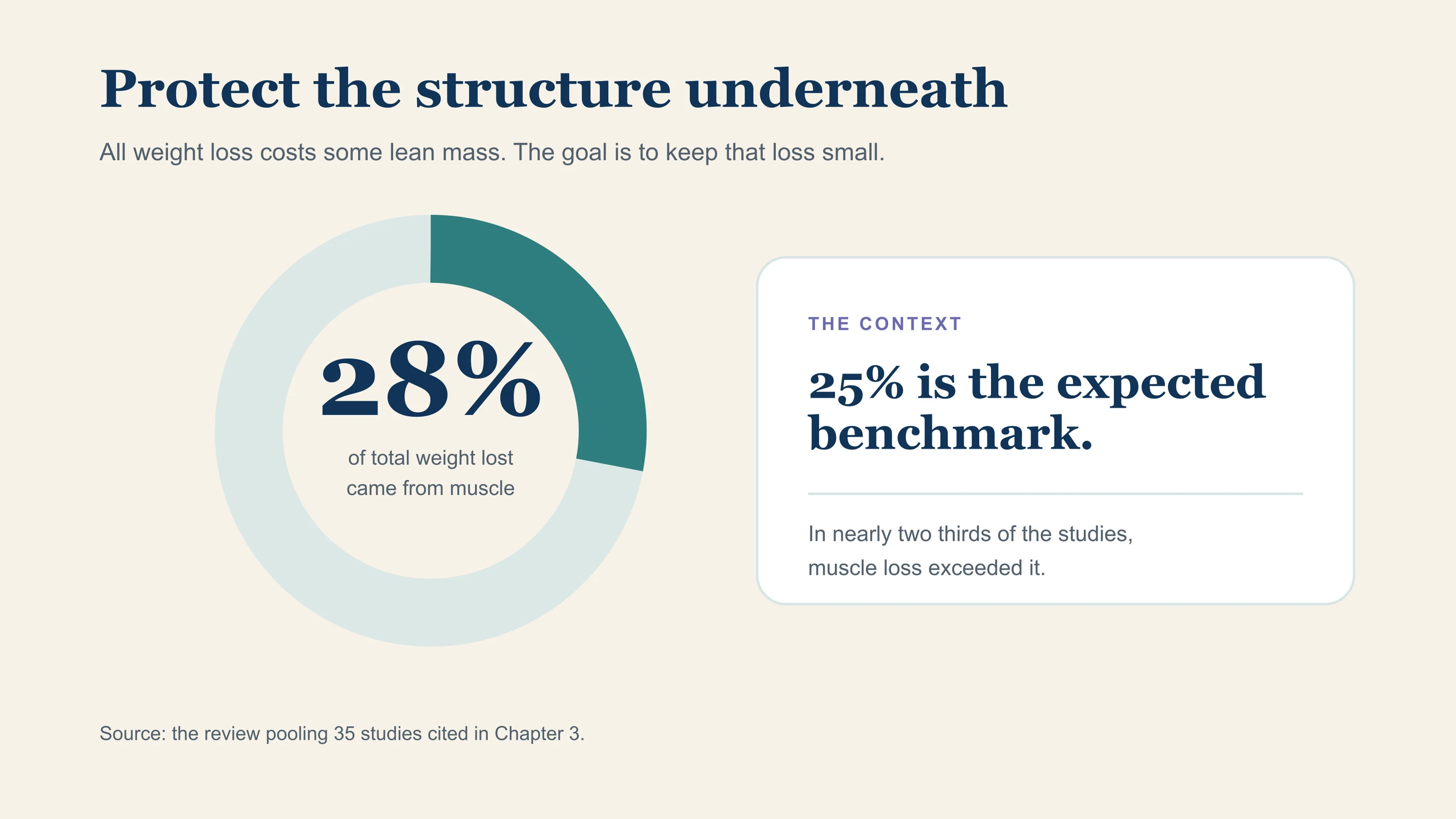
The honest number: roughly 28 percent, against a 25 percent benchmark for weight loss of any kind.
I would rather hand you that number than a comfortable one. It does not mean the medication is attacking your muscle; cutting calories alone overshoots the same benchmark in a substantial share of studies too. It means that when weight comes off this efficiently, protecting muscle becomes part of the treatment.
Four things protect it, and they work together:
1. Protein at every meal. Aim for one to two grams per kilogram of your ideal body weight — for many adults, 80 to 130 grams a day. With kidney disease, the lower end. Spreading it across meals beats one large serving, and this gets harder as appetite falls, which is exactly why it needs planning.
2. Resistance training two to three times a week. Weights, bands, or bodyweight all count. For preserving muscle this matters more than cardio, and combining the two does more than either alone.
3. Eating enough in the first place. Strange advice in a weight-loss book, but appetite falls far enough that some people drift below what their body needs. Most adults should not sit below roughly 800 to 1,200 calories a day on treatment. Meet your vitamins through whole foods where you can, with a daily multivitamin otherwise — vitamin D, B12, and folate run low most often.
4. Actually measuring it. The scale cannot tell you whether you are losing fat or muscle. It reports one number for two very different outcomes. Body composition testing — InBody, DEXA, or similar — separates them, and it changes what we do next.
Think of it like remodeling a house: clear out the clutter, not the walls.