
Chapter 2 of 10·24 min left in book
Chapter 2
Why the Biology Pushes Back

When body weight falls, the body does not treat the new weight as automatically permanent. Appetite can rise. Food can occupy more mental space. Fullness can arrive later, and familiar cues — a kitchen, a commercial, a late drive home — can feel louder. That is physiology doing what it evolved to do: defend energy stores after a loss.
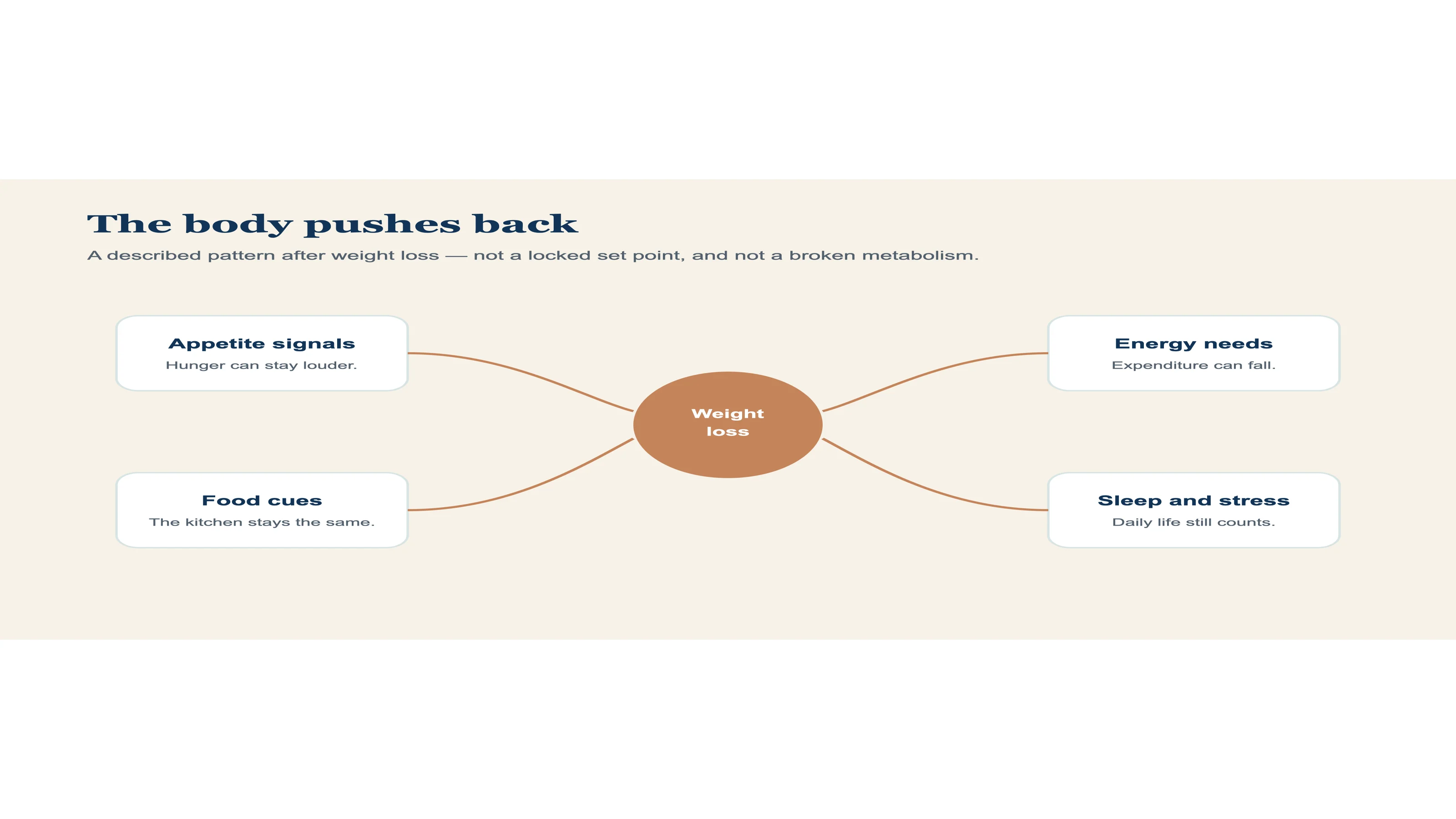
After weight loss, appetite, energy use, food cues, and daily stress can push back together. This is a described pattern, not a locked set point.
After diet-induced weight loss, appetite-related hormones can stay shifted for a year or more. In 2011, Sumithran and colleagues followed fifty adults without diabetes who lost a mean 13.5 kg on a very-low-energy diet. At ten weeks, leptin, peptide YY, cholecystokinin, insulin, and amylin had fallen, while ghrelin and hunger ratings had risen. One year later, those differences from baseline had not fully resolved. Those were observed group findings after diet, in a small sample, not a prediction of your labs after a GLP-1, and not proof that every person will feel the same hunger.
Energy needs also fall. A smaller body burns less simply because there is less tissue to maintain. In some people, expenditure falls more than the new size and composition would predict. Researchers call that adaptive thermogenesis. In 2008, Rosenbaum and colleagues compared people at usual weight with people who had recently lost about 10% and people who had kept a 10% loss for a year. Total and non-resting energy expenditure stayed lower than predicted in both reduced-weight groups. That is a described physiologic response. It is not proof that metabolism is "broken," and it is not evidence of permanent metabolic damage.
Food reward still matters. The same foods, the same hours, and the same household patterns do not disappear because a medicine changed. Sleep loss and stress can raise intake even when someone is trying. Access matters too: a gap in coverage or supply is a change in exposure, not a change in character.
GLP-1 medicines amplify satiety and slow stomach emptying while they are present. When exposure falls — because a dose is reduced, a supply is interrupted, coverage ends, or treatment stops — those supports recede. The appetite and energy-use pressures that were already there become easier to feel. Biology, routine, access, sleep, stress, and activity interact.
None of this requires a mystical set-point number. A more careful way to say it is that multiple systems — appetite signals, energy expenditure, food reward, and the environment those systems meet — tend to favor regain after loss. GLP-1 treatment can quiet some of those systems while it is present. It does not delete them.
The practical implication is modest and important. If hunger returns or food preoccupation increases after a change in exposure, that can be the biology this chapter described. It is information for a plan. It is not evidence that you lacked discipline during treatment.