
Chapter 3 of 10·21 min left in book
Chapter 3
What the Withdrawal Trials Show
The strongest randomized evidence we have is about groups, not about you. Every number below is a mean, a proportion, an observed result, or a model-based estimate from a named trial, over a named period, in a named population. It is not a personal forecast. People in the same trial finished in very different places.
STEP 1 extension (semaglutide 2.4 mg). After 68 weeks, adults with overweight or obesity and without diabetes had lost a mean 17.3% of starting weight on semaglutide versus 2.0% on placebo. Medication and the lifestyle program then stopped. In an exploratory subset of 327 people from selected sites in a few countries, the semaglutide group regained a mean 11.6 percentage points by week 120 — about two-thirds of the prior loss on average — for a net mean 5.6% below starting weight. Most cardiometabolic improvements drifted back toward baseline. Lifestyle support was withdrawn with the drug. Analyses were exploratory. Novo Nordisk funded the trial.
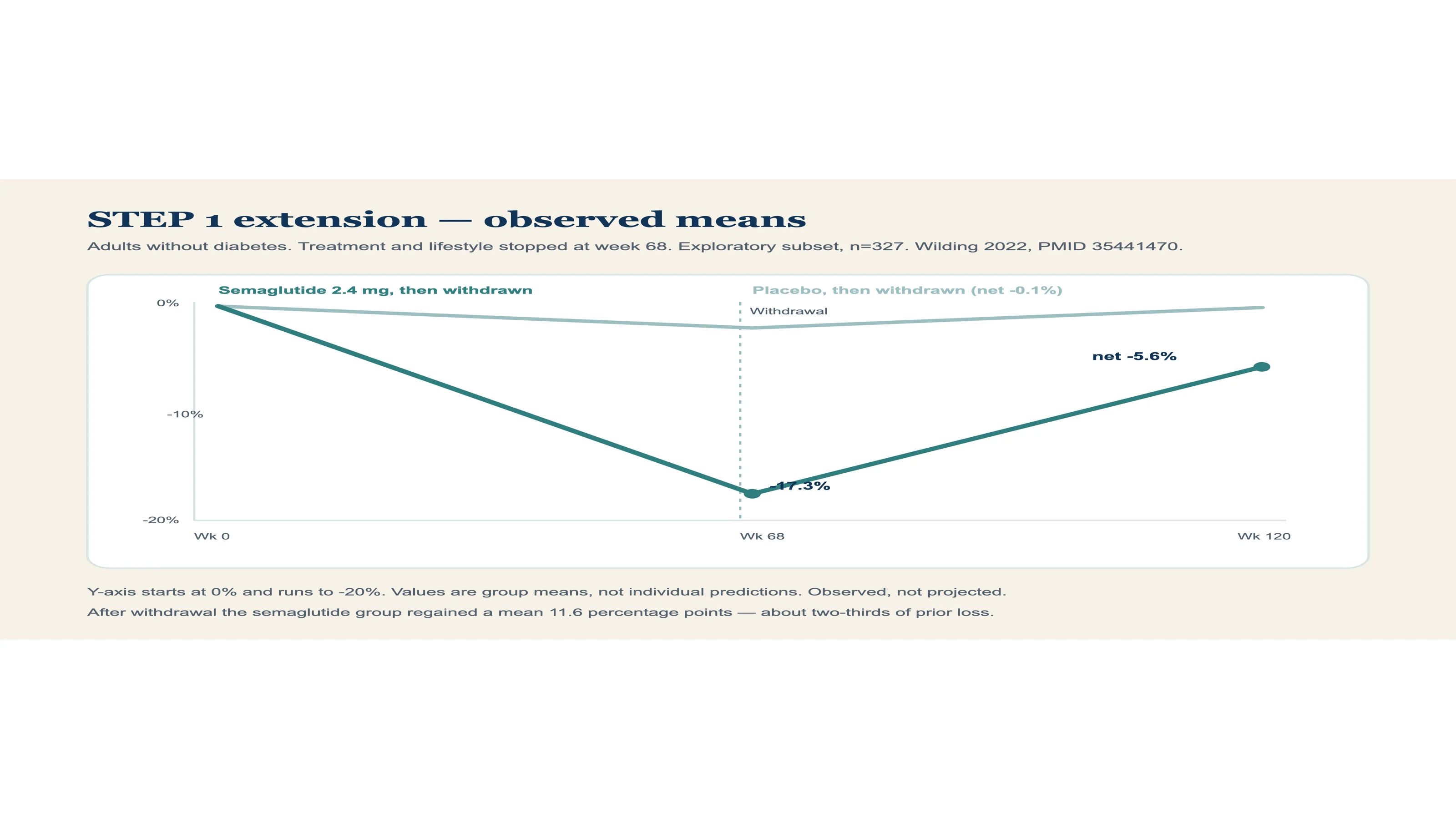
STEP 1 extension, observed means: after withdrawal, the semaglutide group regained about two-thirds of prior loss on average by week 120. Not a personal prediction.
STEP 4 (semaglutide 2.4 mg). Nine hundred two adults began a 20-week run-in. The 803 who reached 2.4 mg — already down a mean 10.6% — were randomized. Over the next 48 weeks, continued semaglutide lost another mean 7.9%; switching to placebo gained a mean 6.9%. The difference was 14.8 percentage points. Only people who tolerated the full dose were randomized, so the comparison is enriched. Lifestyle continued in both arms. No diabetes. Novo Nordisk funded the trial.
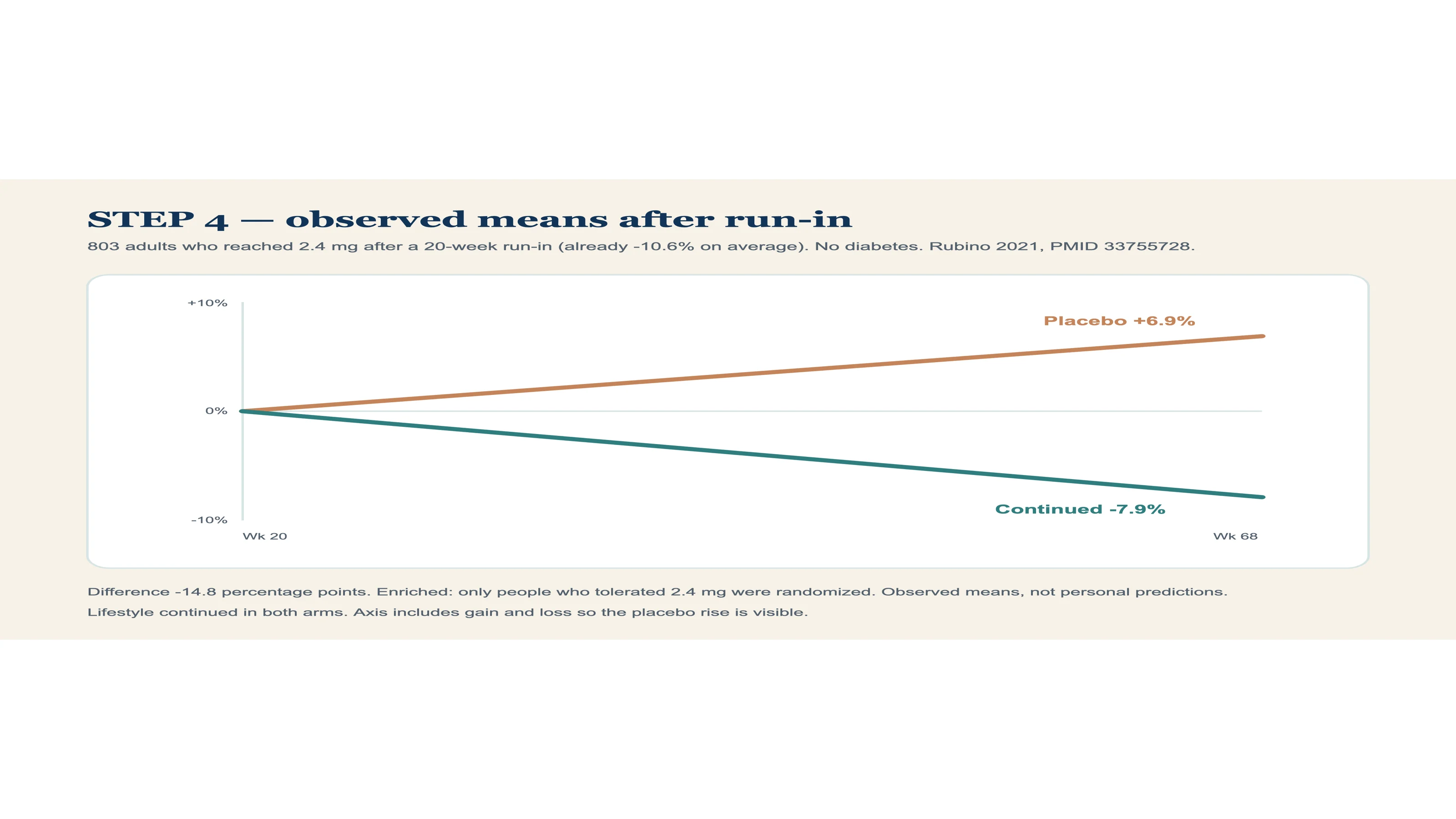
STEP 4, observed means after an enriched run-in: continued semaglutide versus placebo from week 20 to 68.
STEP 5 is not a withdrawal study. Over 104 weeks of continued semaglutide versus placebo, mean weight change was −15.2% versus −2.6%, an estimated difference of 12.6 percentage points. On average, 77.1% versus 34.4% lost at least 5%. It shows what continued treatment maintained in that population, not what happens after stopping.
SELECT followed adults with preexisting cardiovascular disease and overweight or obesity, without diabetes. At 104 weeks, mean weight change was −9.39% with semaglutide versus −0.88% with placebo. A later analysis reported −10.2% versus −1.5% at 208 weeks. This is a cardiovascular outcomes program. It is not a withdrawal design, and the weight averages are smaller than in the dedicated STEP obesity trials — a different population, not a contradiction.
SURMOUNT-4 (tirzepatide). After 36 weeks of open-label maximum tolerated 10 or 15 mg, mean loss was 20.9%. Six hundred seventy people were then randomized. From week 36 to 88, continued treatment lost another mean 5.5%; placebo gained a mean 14.0%. From week 0 to 88, mean change was −25.3% versus −9.9%. On average, 89.5% versus 16.6% kept at least 80% of the lead-in loss. Enriched lead-in. No diabetes. Eli Lilly funded the trial.
SURMOUNT-MAINTAIN is a separate tirzepatide trial, not a head-to-head with SURMOUNT-4. After 60 weeks on maximum tolerated dose, 378 people in the United States were randomized to continue that dose, reduce to 5 mg, or switch to placebo. Model-based estimates from baseline to week 112 were −21.9%, −16.6%, and −9.9%. Rescue treatment could start after week 84 if more than half the lost weight returned. Those figures are model-based estimates in one molecule, at one studied lower dose, after an enriched run-in. They are not a universal tapering strategy.
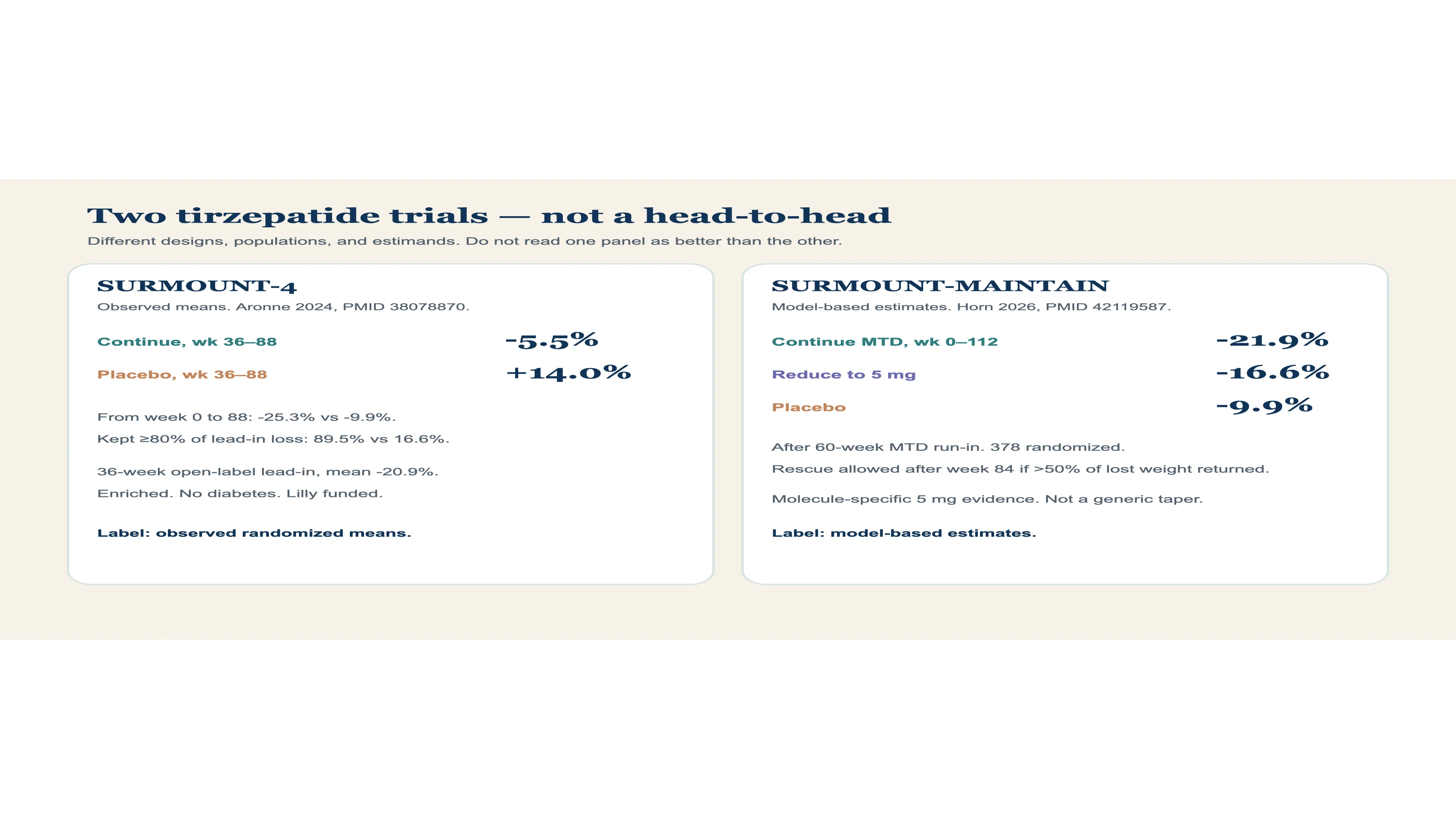
Separate tirzepatide trials. Left: SURMOUNT-4 observed means. Right: SURMOUNT-MAINTAIN model-based estimates. Not a head-to-head comparison.
Real-world cohorts add a different caution. In a large U.S. claims study, most adults who started a dual-labeled GLP-1 had discontinued by one year — 64.8% without diabetes and 46.5% with diabetes, on average. That is a discontinuation rate, not a regain curve, and access and coverage shape it.
Limitations sit on every row: selected or dose-tolerant populations, diabetes exclusions, lifestyle support withdrawn in the STEP 1 extension, sponsor funding, and follow-up that is still short against a lifelong condition. Meta-analytic projections are not the same thing as these observed or model-based trial results. Your course can be smaller, larger, slower, or faster than any average.