
Chapter 5 of 10·14 min left in book
Chapter 5
Maintenance Is More Than Willpower

Maintenance is the work of keeping a life that can hold a lower weight. It is not a character test, and a rising number is not proof of noncompliance.
Hunger and satiety can change when medication exposure changes. That is expected biology. Routines and food environments matter because they are where most calories are decided — the kitchen, the drive-through after a late shift, the office candy, the family meal that arrives already plated. Those environments do not reset themselves when a prescription changes.
Stress and sleep change intake for many people. Work and family schedules decide whether there is time to cook, walk, or lift. Access and follow-up decide whether a rising trend is noticed at week three or month six. Social support can make the next conversation easier. Shame does the opposite: it hides the trend until the number is harder to discuss.
The evidence ladder is uneven, and it should be stated that way.
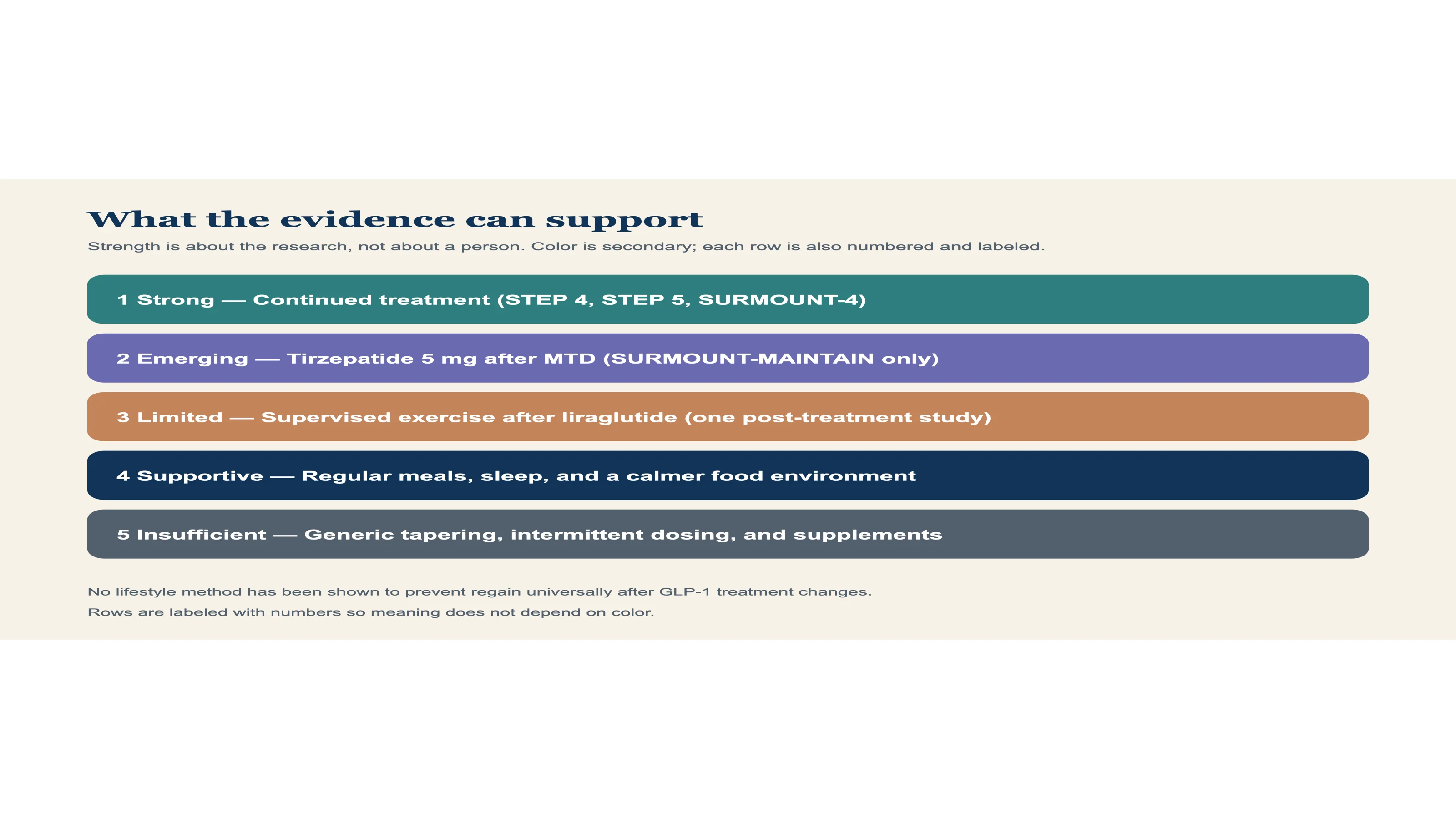
Evidence is uneven. Continued treatment is strongest. Reduced-dose tirzepatide is emerging and molecule-specific. Exercise evidence is limited. Generic tapering and supplements are insufficient.
Strong. Continued treatment has the strongest randomized-trial evidence for maintaining medication-associated weight loss.
Emerging. A lower tirzepatide dose had molecule-specific maintenance evidence in one 2026 trial. That is not a generic reduced-dose rule.
Limited. Supervised exercise after liraglutide had promising post-treatment findings in one study. It has not been shown to prevent regain after semaglutide or tirzepatide withdrawal.
Supportive. Regular meals, sleep, and a less chaotic food environment help many people. They are not a proven universal shield.
Insufficient. Generic tapering, intermittent dosing, supplements, and any single diet marketed as a regain preventer do not have evidence that they work for everyone.
Guidelines from Obesity Canada, the American Diabetes Association, the VA/DoD, and the World Health Organization treat obesity as a chronic condition that often needs long-term follow-up. That is a framing, not a requirement that every person stay on one medicine forever.
Early problem-solving is kinder than self-blame. If hunger is louder, if sleep has collapsed, or if access is about to change, those are planning facts — not proof that you failed.
What you can own is the response: notice the trend, reduce shame, restore sleep and meals where you can, and bring the pattern to a clinician early. What you cannot own is a guarantee. No lifestyle method has been shown to prevent regain in everyone after GLP-1 treatment changes.