
Chapter 3 of 11·14 min left in book
Chapter 3
How Should Testosterone Be Tested?

Testing testosterone correctly matters.
A rushed or poorly done test can lead to the wrong diagnosis.
Start With a Morning Blood Test
Testosterone is usually highest earlier in the day.
For that reason, testosterone is commonly checked in the morning.
If the result is low, it should usually be repeated on another morning.
This matters because testosterone can change from day to day.
Why Do You Need More Than Testosterone?
Finding a low number is only the first step.
The next question is:
Why is it low?
Your brain and testicles work together to make testosterone.
Your doctor may order other tests to learn where the problem may be coming from.
A fuller morning evaluation
- Start
- Morning total testosterone.
- LH
- A brain-to-testicle signal.
- FSH
- A signal involved in sperm production.
- Prolactin
- A clue when the pituitary may be involved.
- Blood count
- A treatment-safety baseline.
- PSA
- A prostate baseline when appropriate.
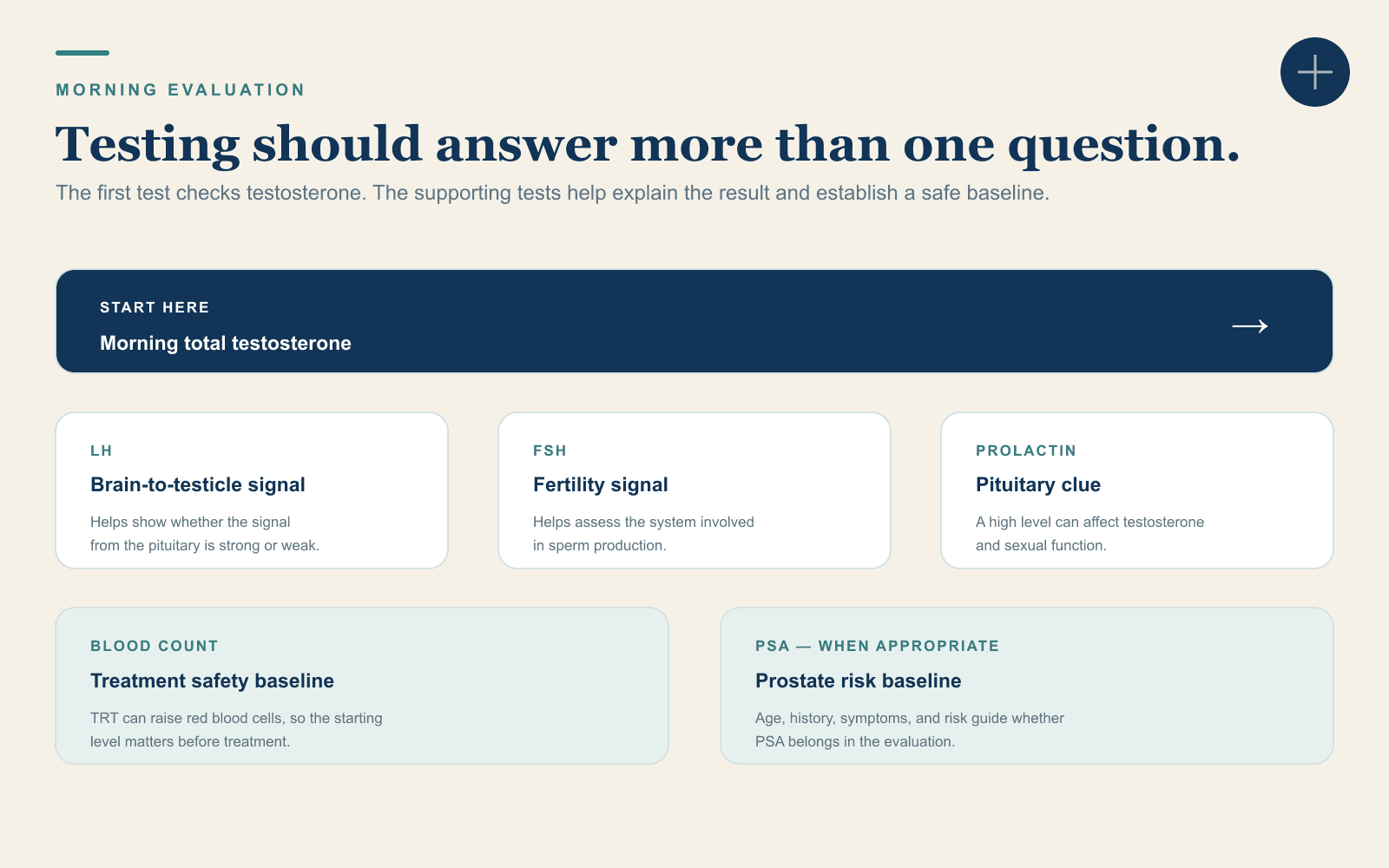
Supporting tests can help explain a low result and establish a safe baseline.
These can include:
LH
LH stands for luteinizing hormone.
It is a signal from the brain that tells the testicles to make testosterone.
FSH
FSH helps control sperm production.
It becomes especially important when fertility is part of the conversation.
Prolactin
High prolactin can sometimes interfere with testosterone production.
It may be checked when your hormone pattern suggests a possible pituitary problem.
Blood count
A blood count checks your red blood cells.
This matters because testosterone can increase red blood cell production.
You want to know where your level is before treatment starts.
PSA
PSA is a blood test related to the prostate.
Whether it is needed depends on your age, health history, prostate risk, and the treatment discussion.
What About Home Testosterone Tests?
At-home testosterone tests are becoming easier to find.
They may be useful as a first look.
If a home result is low, a proper clinical evaluation should confirm the finding.
The Big Point
A good testosterone evaluation is not:
“Your testosterone is 280. Here is a prescription.”
It should answer:
Is your testosterone truly low?
Do your symptoms fit?
Why might it be low?
Is TRT the right treatment for you?