
Chapter 9 of 11·5 min left in book
Chapter 9
What Good Testosterone Care Should Look Like
Testosterone treatment is easy to sell.
Good testosterone care is harder.
There is a difference.
A good program should not begin with:
“Which testosterone package do you want?”
It should begin with:
“What is going on, and is testosterone actually the right treatment?”
Before You Start TRT
A good evaluation should look at:
Your symptoms
What changed?
When did it start?
Which symptoms matter most to you?
Your testosterone level
Was it checked correctly?
Was a low result confirmed?
The possible cause
Why might your testosterone be low?
Could sleep, weight, medicine, illness, or another hormone problem be involved?
Fertility
Do you want children now or in the future?
This should be discussed before treatment.
Blood count
Your hematocrit should be known before TRT because treatment can increase it.
Blood pressure
Blood pressure should be checked and followed.
Prostate risk
For men where it is appropriate, prostate history and PSA should be reviewed.
Your overall health
Heart disease, sleep apnea, blood clots, medications, and other conditions may affect the plan.
After TRT Starts
Starting testosterone is not the end of care.
It is the beginning of monitoring.
Your monitoring plan
After TRT starts, your clinician should follow
- Your symptoms
- Your testosterone level
- Your blood count
- Your blood pressure
- Side effects
- Your prostate/PSA when appropriate
- Whether the treatment is actually helping
More Testosterone Is Not Always Better
One of the biggest mistakes in testosterone care is chasing the highest possible number.
If 600 is good, that does not mean 1,200 is twice as good.
Higher levels may create more side effects without creating more benefit.
The goal is not to win a testosterone contest.
The goal is:
Feel better. Stay safe. Treat the real problem.
What If Your Testosterone Improves but You Do Not?
This is another important question.
Maybe testosterone was not the main cause.
Maybe another condition needs attention.
Good medicine is willing to ask that question.
Good care follows a sequence
- Before
- Review symptoms, testing, possible causes, fertility, and safety.
- After
- Monitor symptoms, testosterone, blood count, blood pressure, side effects, and prostate health when appropriate.
- Reassess
- If the number improves but symptoms do not, reconsider the cause.
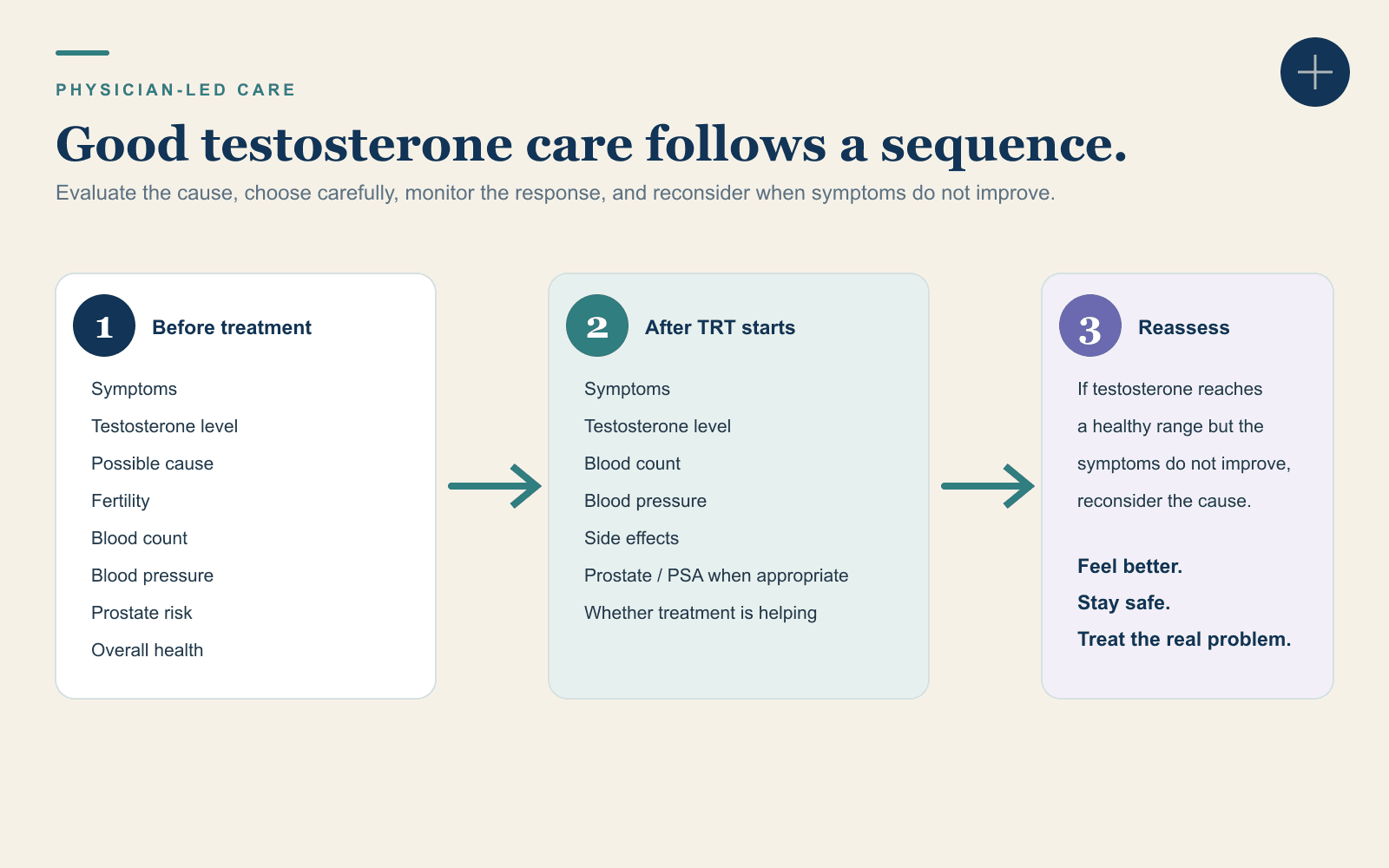
Evaluate the cause, choose carefully, monitor the response, and reconsider when symptoms do not improve.