
Chapter 7 of 11·8 min left in book
Chapter 7
What Are the Main Risks and Side Effects of TRT?
TRT can be very helpful.
It also needs monitoring.
That is not a reason to fear treatment.
It is a reason to do treatment properly.
Treatment needs a monitoring plan
- Watch
- Blood count, blood pressure, skin and breast symptoms, fertility, and clinical benefit.
- Discuss
- Heart and blood-vessel history, prostate risk, and future fertility.
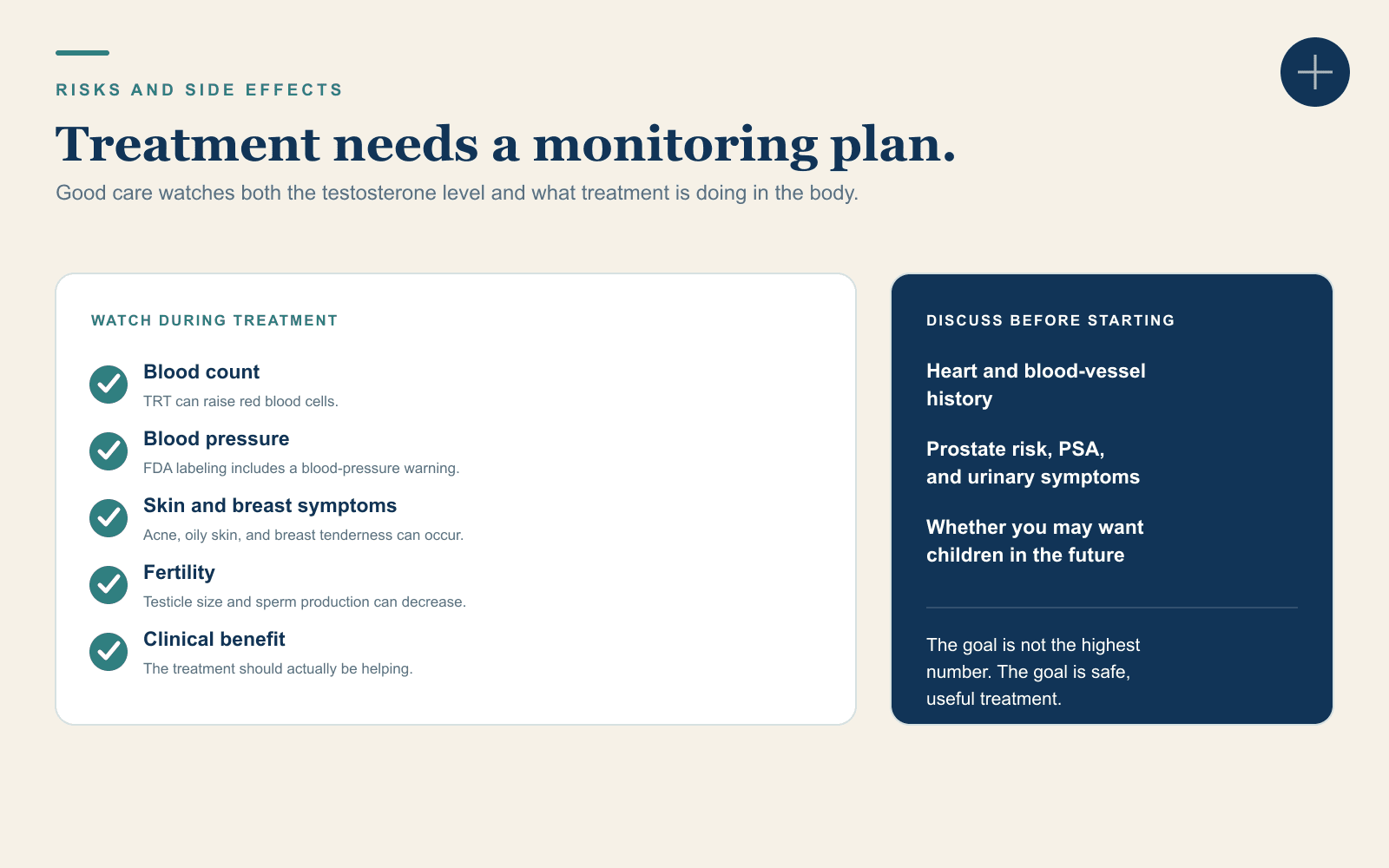
Good care watches both the testosterone level and what treatment is doing in the body.
High Red Blood Cell Count
This is one of the most important side effects to understand.
Testosterone tells your body to make more red blood cells.
Sometimes the level can become too high.
This is called erythrocytosis.
Your doctor monitors a blood test called hematocrit.
If hematocrit gets too high, your treatment may need to be changed or paused while the cause is addressed.
This is one reason a good testosterone program includes regular blood work.
Blood Pressure
Testosterone can raise blood pressure in some men.
The FDA now requires testosterone products to carry warnings about this risk.
Blood pressure should be checked before and during treatment.
Acne and Oily Skin
Some men develop:
- Acne
- Oily skin
- Increased body hair
These effects are usually manageable.
Breast Tenderness
Some men can develop breast tenderness or breast enlargement.
This is not one of the most common problems, but it can happen.
Testicle Size and Sperm Production
Taking testosterone from outside the body can cause the testicles to make less of their own testosterone.
The testicles may become smaller.
More importantly, sperm production can drop.
This is especially important for younger men who want children.
We will cover fertility in the next chapter.
Does TRT Cause Heart Attacks?
This question has scared many men.
The best large study so far—the TRAVERSE trial—looked at more than 5,000 men with low testosterone who already had heart disease or were at high risk for it.
Testosterone did not cause more heart attacks, strokes, or cardiovascular deaths than placebo.
That is reassuring.
But that does not mean TRT has zero cardiovascular risk.
Your monitoring plan
TRAVERSE also found more cases of
- Atrial fibrillation, an abnormal heart rhythm
- Pulmonary embolism, a blood clot in the lungs
- Acute kidney injury
Long-term safety also continues to be studied.
Long-term safety also continues to be studied.
So the right message is not:
“Testosterone is dangerous.”
And it is not:
“Testosterone has no risk.”
The better message is:
Does TRT Cause Prostate Cancer?
This is another major concern.
Current evidence does not show that properly prescribed TRT simply causes prostate cancer.
Large modern studies have been reassuring.
But prostate health still matters.
Testosterone can raise PSA.
Your monitoring plan
Prostate health still matters
- Your age
- PSA level
- Family history
- Prior prostate problems
- Urinary symptoms
- Overall prostate cancer risk
The goal is not to ignore the prostate.
The goal is to use current evidence instead of outdated fear.