
Skip to content
WellForm MD
An Asian woman seated in a black chair in a bright modern lounge, with quiet glass wall space to her left

Investigational peptide evaluation

BPC-157 Peptide Consultation in Ankeny, Iowa

Interested in BPC-157 for recovery? Start with the evidence and your health history—not a promise of faster healing. WellForm MD offers clinician-guided consultations for adults asking about BPC-157. When a lawful current product source is available and treatment is clinically appropriate, the visit can determine whether the WellForm MD BPC-157 Recovery Program belongs in your care plan. BPC-157 is not FDA-approved, and human evidence remains limited.

  • $299/month
  • Clinician-guided
  • Investigational peptide
  • Ankeny, Iowa
  • Human evidence remains limited

Investigational

BPC-157 is not an FDA-approved treatment for injury recovery, pain, tendon healing, muscle healing, or gastrointestinal conditions.

Human Evidence Is Limited

Most published BPC-157 research is preclinical. Human studies remain small and insufficient to establish reliable effectiveness or long-term safety.

Start With Clinical Review

If you are asking about BPC-157, the first question should be whether it is appropriate, currently available through a lawful source, and worth considering at all.

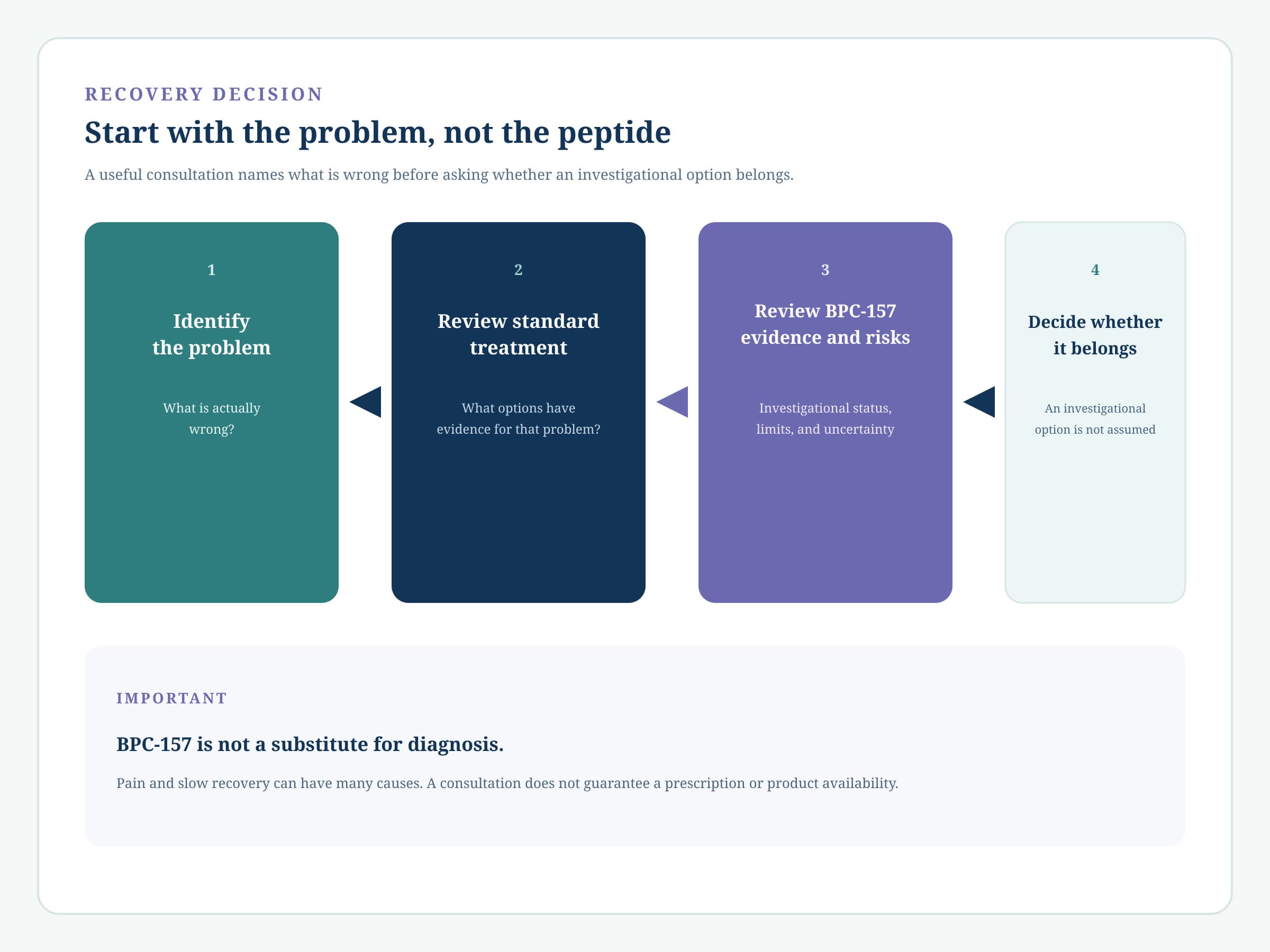
Four-stage diagram: identify the problem, review standard treatment, review BPC-157 evidence and risks, then decide whether an investigational option belongs

Start with the problem, not the peptide

BPC-157 is not a substitute for diagnosis

Pain and slow recovery can have many causes. A tendon tear, arthritis, stress fracture, muscle injury, nerve problem, inflammatory condition, or other disorder should not be reduced to: “I need BPC-157.” A useful consultation starts with: What is actually wrong? Then: What options have evidence for that problem? And only then: Does an investigational peptide belong anywhere in the discussion?

Identify the problem

Start with the actual injury, persistent discomfort, recovery concern, or other reason you are considering BPC-157.

Review standard treatment

An investigational peptide should not replace appropriate evaluation or established treatment.

Review BPC-157 evidence and risks

If BPC-157 remains relevant, we review its investigational status, the limits of human evidence, uncertainties, current availability, regulatory considerations, and alternatives.

Decide whether it belongs

A consultation does not guarantee access to BPC-157. Current lawful sourcing and regulatory status must be confirmed before a treatment plan can proceed.

The page should not guarantee that BPC-157 can be prescribed or dispensed simply because this page exists.

How a BPC-157 consultation works

Clinician-guided, not product-first

The program is structured around clinician review and treatment guidance rather than purchasing an unmonitored peptide product. You do not need to arrive certain that BPC-157 belongs in your plan.

  1. 1

    Tell Us What You Are Trying to Address

    Start with the actual problem: an injury, persistent discomfort, recovery concern, training-related concern, or another reason you are considering BPC-157.

  2. 2

    Review the Diagnosis and Standard Options

    An investigational peptide should not replace appropriate evaluation or established treatment. Your clinician reviews your history and whether additional evaluation or conventional care makes more sense.

  3. 3

    Review What BPC-157 Actually Is

    If BPC-157 remains relevant to the discussion, we review its investigational status, limitations of the human evidence, potential uncertainties, current availability, regulatory considerations, and alternatives.

  4. 4

    Determine Whether Treatment Is Even Available

    A consultation does not guarantee access to BPC-157. Current lawful sourcing and regulatory status must be confirmed before a treatment plan can proceed.

  5. 5

    Make an Informed Decision

    If a current lawful option exists and you remain an appropriate candidate, your individualized plan is reviewed before treatment.

Why do people ask about BPC-157?

These are reasons people ask about BPC-157

They are not established indications or guaranteed treatment outcomes. If you have an injury, persistent pain, gastrointestinal symptoms, or another medical problem, the appropriate diagnosis and standard treatment options should not be skipped in favor of a peptide.

  1. 1

    Exercise recovery

    People commonly become interested in BPC-157 while dealing with questions related to exercise recovery.

  2. 2

    Tendon or ligament concerns

    People commonly become interested in BPC-157 while dealing with questions related to tendon or ligament concerns.

  3. 3

    Muscle injuries

    People commonly become interested in BPC-157 while dealing with questions related to muscle injuries.

  4. 4

    Persistent musculoskeletal discomfort

    People commonly become interested in BPC-157 while dealing with questions related to persistent musculoskeletal discomfort.

  5. 5

    Joint concerns

    People commonly become interested in BPC-157 while dealing with questions related to joint concerns.

  6. 6

    Recovery after training or activity

    People commonly become interested in BPC-157 while dealing with questions related to recovery after training or activity.

  7. 7

    Gastrointestinal concerns

    People commonly become interested in BPC-157 while dealing with questions related to gastrointestinal concerns.

Who should consider a consultation?

A consultation may be reasonable

A consultation may be reasonable if you want a medically grounded explanation of BPC-157. The consultation is not a promise that BPC-157 will be prescribed. BPC-157 should not delay proper evaluation of a problem that needs established medical treatment. The underlying diagnosis comes first.

  • You have heard about BPC-157 and want a medically grounded explanation.
  • You want to understand the current evidence.
  • You have a recovery concern and want to discuss whether your underlying diagnosis needs additional evaluation.
  • You want to understand the potential risks and alternatives.
  • You want to know whether a lawful current BPC-157 option is available.
  • BPC-157 should not delay proper evaluation of significant or worsening pain.
  • BPC-157 should not delay evaluation of a suspected tendon or ligament rupture, suspected fracture, weakness, or neurologic symptoms.
  • BPC-157 should not delay evaluation of joint swelling or infection, gastrointestinal bleeding, persistent unexplained abdominal symptoms, or postoperative complications.

What to bring to your consultation

Be prepared to discuss

Bring the information that helps the visit start with the problem rather than the peptide name.

  • The problem you are trying to address
  • How long it has been present
  • Prior diagnosis
  • Imaging, if available
  • Previous treatment
  • Physical therapy or rehabilitation
  • Current medications
  • Supplements or peptides
  • Relevant medical conditions
  • Whether you participate in drug-tested sport

What the human evidence actually shows

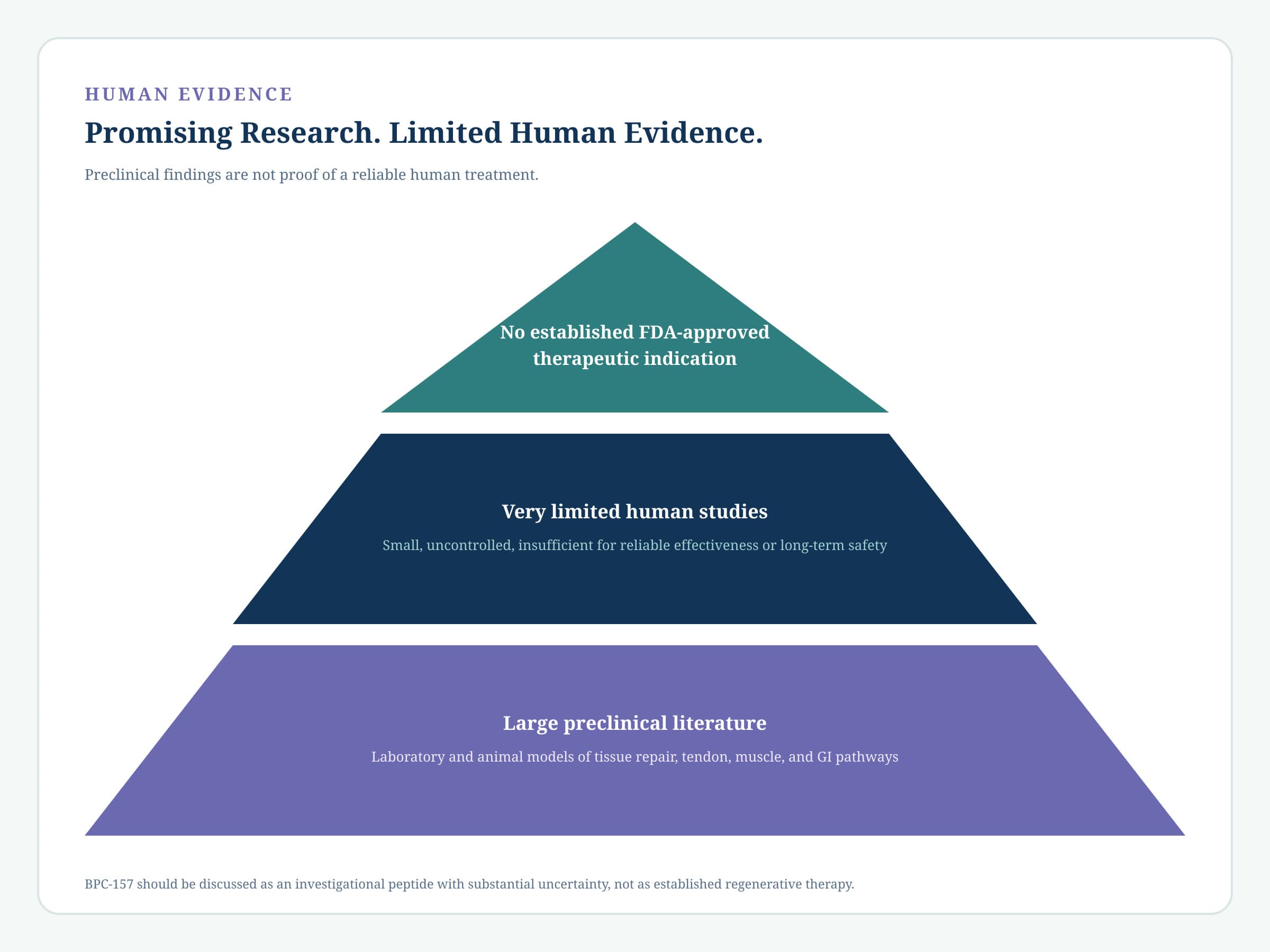
Promising preclinical research is not proven human treatment

BPC-157 has an extensive preclinical literature. Animal and laboratory studies have reported effects involving tissue repair, tendon and muscle models, angiogenesis, and inflammatory pathways. Human evidence is much smaller. A 2025 systematic review of BPC-157 in orthopaedic sports medicine found 35 preclinical studies and only one clinical study among the included evidence. The human study was a small retrospective series involving knee pain. A more recent 2026 review noted that available clinical information comes from fewer than 30 people across three uncontrolled pilot studies, with no completed Phase II clinical trial and no validated pharmaceutical formulation or dosing regimen. BPC-157 should be discussed as an investigational peptide with substantial uncertainty, not as an established regenerative therapy.

What about the small human knee study?

  • A small retrospective report evaluated BPC-157 in people with knee pain.
  • The study involved a very small number of patients, lacked a randomized placebo-controlled design, and used subjective follow-up.
  • Although some participants reported improvement, the study cannot establish that BPC-157 reliably treats knee pain or repairs damaged tissue.
  • That study is useful as an early signal for future research. It is not strong enough to support promises of clinical benefit.
  • Safety is also uncertain. The absence of a large number of reported adverse events does not establish that BPC-157 is safe. Human exposure remains limited.

WellForm MD does not promise that BPC-157 will

  • Heal a tendon
  • Repair a ligament
  • Regrow cartilage
  • Heal a muscle tear
  • Eliminate joint pain
  • Speed surgical recovery
  • Prevent injury
  • Improve athletic performance
  • Heal the gastrointestinal tract
  • Replace physical therapy
  • Replace surgery
  • Replace evidence-based medical treatment

What is BPC-157?

A synthetic 15-amino-acid peptide with limited human evidence

BPC-157 is a synthetic peptide consisting of 15 amino acids. It has generated substantial interest because laboratory and animal research has reported biological effects involving tissue-repair pathways, angiogenesis, inflammatory signaling, tendon and muscle models, and gastrointestinal models. These findings are primarily preclinical. They should not be interpreted as proof that BPC-157 heals injuries, repairs tendons, eliminates pain, accelerates recovery, or produces the same effects in humans. That distinction is central to how WellForm MD discusses BPC-157.

Evidence pyramid labeled Promising Research. Limited Human Evidence, from a large preclinical literature through very limited human studies to no established FDA-approved therapeutic indication

Why WellForm MD?

Clinician-guided evaluation

You start with the medical question rather than a peptide checkout page.

  • Clinician-Guided Evaluation

    You start with the medical question rather than a peptide checkout page.

  • Honest Evidence Boundaries

    Promising animal research is not presented as established human benefit.

  • Regulatory Awareness

    Current lawful availability and sourcing are verified before treatment proceeds.

  • Product Transparency

    If treatment is considered, you should understand exactly what product is being prescribed and where it comes from.

  • Flexible Monthly Pricing

    Start at $299/month without paying for several months upfront.

  • Save With Three Months

    Choose $799 for 3 months and save $98 compared with paying monthly.

  • Broader Medical Perspective

    A recovery concern may need imaging, rehabilitation, physical therapy, orthopedic evaluation, lifestyle changes, or another medical treatment. BPC-157 is not automatically the answer.

Current BPC-157 Recovery Program

BPC-157 Recovery Program Starting at $299/Month

You do not need to make a large upfront commitment to start. The monthly option gives you the flexibility to begin a clinician-guided BPC-157 evaluation without purchasing three months in advance. You can also choose a discounted 3-month option. Three months paid individually: $897. The three-month option is $799. Save $98. Effective monthly cost: $266/month. A consultation does not guarantee a BPC-157 prescription or product availability. Current regulatory status, lawful sourcing, and clinical appropriateness must be confirmed before treatment.

Monthly

Monthly BPC-157 Recovery Program

$299/month

Flexible month-to-month clinician-guided evaluation.

  • Clinician review
  • Protocol selection when appropriate
  • Medication coordination
  • Patient education
  • Treatment guidance
  • Treatment remains subject to clinical appropriateness, current lawful availability, and the exact product source.

Best Value

$799 for 3 months

$799

Save $98 · Effective monthly cost $266/month

  • Three monthly payments would total $897.
  • Save $98.
  • Effective monthly cost: $266/month.
  • Available for patients who prefer a longer treatment period at a lower overall price.
  • You do not need to purchase three months upfront to start a BPC-157 consultation.

Program Framework

Clinician review; protocol selection when appropriate; medication coordination; patient education; treatment guidance.

May Be Separate Unless Specifically Included

Laboratory testing; shipping; supplies; additional follow-up visits.

Important

A consultation does not guarantee a BPC-157 prescription or product availability. Current regulatory status, lawful sourcing, and clinical appropriateness must be confirmed before treatment.

A consultation does not guarantee a BPC-157 prescription or product availability. Current regulatory status, lawful sourcing, and clinical appropriateness must be confirmed before treatment. Treatment availability and individual results are not guaranteed.

$299/month

Book a Free Consultation

$299/month · Clinician-guided · Investigational peptide · Ankeny, Iowa · Human evidence remains limited

The regulatory status is important

BPC-157 is not FDA-approved

BPC-157 is not an FDA-approved medication for human therapeutic use. Its U.S. compounding status has also been under active review. In July 2026, FDA staff recommended against adding BPC-157 free base and BPC-157 acetate to the Section 503A Bulks List, citing limited characterization, insufficient safety information, immunogenicity concerns, and inadequate evidence for the indication FDA evaluated. The Pharmacy Compounding Advisory Committee subsequently voted to recommend inclusion, but advisory-committee recommendations are not themselves FDA approval or a final regulatory determination. As of September 2026, final federal action remained pending. For WellForm MD, the practical rule: do not promise availability until the current legal and pharmacy pathway has been verified.

  • Before treatment, WellForm MD must confirm current lawful product availability.
  • Appropriate pharmacy/source must be confirmed.
  • Current federal and state compounding requirements must be confirmed.
  • Individual clinical appropriateness must be confirmed.
  • FDA has previously identified concerns including possible immunogenicity and complexities involving peptide-related impurities and active-pharmaceutical-ingredient characterization.
  • Competitive athletes need to know that BPC-157 has been listed by the World Anti-Doping Agency under the category of non-approved substances prohibited at all times.
  • Athletes subject to drug-testing rules should review the current rules that apply to their sport before considering BPC-157.
  • WellForm MD should not market BPC-157 as a sports-performance enhancer.

BPC-157 consultation in Ankeny, Iowa

Clinician-guided wellness care from our Ankeny clinic

WellForm MD provides clinician-guided wellness care from our Ankeny clinic for adults throughout Ankeny and the greater Des Moines area. If you are considering BPC-157, start with a conversation about what you are trying to treat, what the human evidence actually shows, what is uncertain, what alternatives exist, and whether a current lawful treatment pathway exists. WellForm MD, 2675 N Ankeny Blvd, Suite 113, Ankeny, Iowa 50023. Phone: (515) 717-7648.

Ask a question

FAQ

Questions before you book

Clear answers to the questions most likely to affect your decision.

Considering BPC-157?

Start With the Evidence.

Tell us what you are trying to recover from and what you have already tried. We will help you understand what BPC-157 is, what human evidence exists, what remains uncertain, what conventional options may be appropriate, whether a lawful current BPC-157 pathway exists, and whether it belongs in your care plan at all. $299/month or $799 for 3 months — save $98. WellForm MD, 2675 N Ankeny Blvd, Suite 113, Ankeny, Iowa 50023, (515) 717-7648. BPC-157 is investigational and is not FDA-approved for human therapeutic use. Treatment availability and individual results are not guaranteed.

A clinician and an adult discussing a recovery plan across two chairs